Showing posts with label gold standard. Show all posts

Wednesday, April 25, 2018

Confiscation: Gold as Contraband

Confiscation: Gold as Contraband 1933-1974 by Kenneth R. Ferguson was a pleasure to read. Ferguson writes well. I met Ken Ferguson in person at a coin show here in Austin. He speaks as intelligently as he writes. Our time together was enlightening. 

Few people ever get past citing Executive Order 6102. Even when they do point to that document, they most often stop short of fully citing and discussing it. This book delivers the facts. Ferguson tells the whole story, going past 6102 to the subsequent orders and laws. He lays out carefully and logically the many relevant details that highlight this singular event. He also examines the public response. I was impressed with his explanations of how and why Britain, France, and Switzerland returned to striking gold coins after World War II, using dies from previous years. 

This book carefully explains the intentions and consequences of the rolling orders and laws that redefined the monetary policy of the American government in the 1930s. On the first level, obviously, the goal was to get gold into the U.S. Treasury in order to meet foreign obligations. Moreover, the revaluation of the dollar did more than expand the money supply, though it did that. When the official price of gold moved from $20.67 per ounce to $35 per ounce, all of the paper profits went to the Treasury. Citizens who turned gold in were paid at the face value of the coins (or the equivalent for bullion), $20 for a $20 double eagle, not $33.86. 

As for whether surrendering gold was necessary, Ferguson demonstrates from several perspectives why it was not. Other nations made similar changes – demonetizing gold, going off the gold standard – without confiscating the private property of their citizens. That is a theme that Ferguson returns to often as he dissects the events and laws. If gold is money, then Congress (not the President) is authorized to define how much goes into what coins. That happened in 1834, for example. If gold is private property, then its uses as money are irrelevant in that context. Moreover, and most insightful (and damning) Ferguson shows that (1) Treasury stocks were not greatly improved by this law (though the Treasury did profit directly), and (2) the reason why is that half the gold in private holdings in the United States remained with its owners. People just ignored the law, as they had Prohibition earlier.

In 180 pages, this book provides a close and yet conversational examination of Franklin D. Roosevelt’s executive orders and the related Congressional acts that became laws. Ferguson identifies and explains the half dozen presidential orders and parallel banking acts, the criminalization of gold ownership, and the exclusions left open to numismatists. Turning to the international theater, the presentation builds on the official purposes of the Bretton Woods accords to illuminate the history of the 1950s and 1960s.  It was that context which provided the impetus for President Gerald Ford to lift all of those restrictions in 1974. 

From there, Ferguson considers the modern world, whether and to what extent gold is money, whether and to what extent it is an investment, and the prospects for a repeat of the draconian laws of the 1930s. That last is too often a springboard for ideologues who sell gold coins to harry the public into buying them. As a professional dealer in numismatic rarities, Ferguson shows more aplomb. 

Ferguson earned his master’s degree from the Lyndon B. Johnson School of Public Affairs at the University of Texas at Austin. Since then, he was worked as a coin dealer. Those two facts explain why this book rests on careful research. His bibliography of 35 sources includes works by both John Kenneth Galbraith and Milton Friedman as well as authorities such as Q. David Bowers, John Craig, and Hans Schlumberger who are recognized within the numismatic community.

The weekend before, I attended a three-day seminar for authors on self-publishing. It was well worth the money. This book was published by the author and Ferguson did it right. The book is set in 11-point Garamond, which the user experience designers here in Austin assure me is the new standard in Roman (serif) fonts.  Of course, it is perfect bound. Ferguson told me that he turned for help to a professional editor. From the seminar I attended the weekend before, I learned how much he paid for the ISBN. It makes a difference in the professional presentation of any work that claims authority. Confiscation: Gold as Contraband 1933-1974 by Kenneth R. Ferguson adheres to that standard.

PREVIOUSLY ON NECESSARY FACTS


Sunday, March 11, 2018

Senator Thomas Hart Benton

After thirty years as Missouri’s U.S. Senator, Thomas Hart Benton’s fall from power was immediate and complete. His loyalty to his values made him a subject for John Kennedy's Profiles in Courage.

(An earlier edition was published by the Georgia Numismatic Association’s, GNA Journal as The Senator Who Fell From Grace with the South.)
State Historical Society of Missouri

Thomas Hart Benton was born at Harts Mill, near Hillsboro, N.C. on March 14, 1782. His father died in 1791, leaving behind claims to land in Tennessee where Thomas settled the family. Mostly self-taught, he earned admission first to Chapel Hill College and then to William and Mary College where he studied law. Returning to Tennessee, he was admitted to the bar in 1806. In 1809 he won election to the state senate, serving one term.

When the War of 1812 broke out, Andrew Jackson tapped Benton to be his aide-de-camp. Jackson mustered 2500 men marching them from Nashville to Natchez, claiming that he would seize Mobile and Pensacola. Instead, Secretary of War John Armstrong disbanded the army. Jackson hired transportation and led them back to Nashville. Benton's petitions to the War Department finally garnered a reimbursement on expenses for Jackson.

As the army ended its campaign, Thomas's younger brother, Jesse, challenged William Carroll to a duel. Carroll asked Jackson to be his second. Jackson declined. On Monday, June 14, 1813 at six o'clock in the morning, Jesse Benton suffered a bullet wound to both cheeks of his buttocks. Hardly fatal, it was painful and embarrassing; and Thomas Benton blamed Jackson. Benton felt that Jackson should have prevented the dual by persuasion. (Although punishable now under the Uniform Code of Military Justice, in the 19th century duelling per se was not contrary to the Rules of War published by Congress. See A Treatise on the Military Law of the United States: Together with the Practice and Procedure of Courts-martial and Other Military Tribunals by George Breckenridge Davis, John Wiley & Sons, 1913, on Google Books here.) 

In early September 1813, the Bentons had their revenge. They ambushed Jackson, John Coffee, and Stockley Hays at the Old Nashville Inn. Thomas Hart Benton pulled a horseship on Jackson. Jesse Benton shot Jackson twice, leaving him with a ball and a slug. Jackson's return fire and the Bentons’ answering barrage all failed. Coffee, Hays, and a bystander, James Sitler, rushed in and overpowered Jesse. In the fracas, Thomas fell backwards down a flight of stairs. The battle ended. (Although the ball was removed, Jackson carried the slug for the rest of his life.) When Jackson and Benton met face to face again in 1823, their common vision and political goals made them allies. They erased the ten years of enmity with a handshake.

Benton was instrumental in developing the West. He introduced bills to distribute lands in ways that allowed true settlement by farmers while thwarting speculators. He advocated for the pony express, the telegraph, interior highways, the opening of the Oregon and Santa Fe trails, and transcontinental railroads. He even hoped that explorers of the far northwest would find a land route to India. 
Bentonian Mint Drop
Hard Times Token
Stacks Bowers at coins.com
The “Bentonian Currency Mint Drop” tokens lampooned Benton's faith in hard money. According to historian William Graham Sumner, Benton was “...the strongest bullionist in the administration circle.” Benton said that gold was the best protection for the middle class, the merchant, farmer, and tradesman. He said that none of them could expect by their honest labor to become rich overnight whereas paper money allowed eastern speculators to do just that.
"New York, Deveau Liberty Head and Mint Drop Hard Times Token.
This token typically receives the Hard Times Designation of HT-251.
The obverse text reads 'PB&S Deveau’s
156 Chatham Square N. York' "
Deveau’s was a shoe store.
From Stacks Bowers via coins.com
To bring American gold into line with the international gold-silver ratio, Benton introduced the legislation that lowered the fineness of the Half Eagle $5 gold coin to from .9167 to .8992 for the issues of 1834-1839. Working with Sen. William McKendree Gwin of California, he introduced a bill to establish branch Mint at San Francisco. Benton's power made him chair of many important committees, including Indian Affairs, Military Affairs, and Foreign Relations. He authored the resolution to expunge from the Senate Journal the resolution of censure against Andrew Jackson.

A westerner and a southerner, Benton's ultimate loyalty was to the Union. Not even his passion for the West - John Fremont was his son-in-law - would allow him to go along with the Compromise of 1850, hammered out by Daniel Webster and Henry Clay. To Benton, it was a surrender to the fire-eaters who threatened dissolution of the Union if they were not allowed to extend slavery into the West.

Yet, though personally opposed to slavery, Benton was no abolitionist. So, when he fell from grace with the South for this stand, he had no friends in the North, and no friends at home in Missouri. The first U.S. Senator to serve five consecutive terms, Thomas Hart Benton suffered a humiliating defeat in 1850. After losing his senate seat, Benton won a single term in the House of Representatives from 1853 to 1855, but his political career was over. He retired to Washington DC to write his autobiography. Benton died on April 10, 1858.

When he was on the rise and powerful, Benton's name christened towns and counties in the West and South: Fort Benton, Montana; Benton County, Iowa, Benton County, Oregon, and Benton County, Washington. After his fall, Benton County, Alabama, became Calhoun County. Benton County, Florida, reverted to Hernando County. However, after the Civil War, Brunson Harbor, Michigan, was renamed Benton Harbor in his honor. 
“During his years as a senator, Benton became concerned that the issue of slavery would divide the country. He had pushed for Missouri to be admitted as a slave state, viewing the abolition of slavery as dangerous to the union and harmful to blacks.Around 1835 Benton slowly began to change his views. While he did not view slavery as wrong or wish to abolish it completely, he did not want to see it spread into the territories.  
“In 1849 Benton traveled around Missouri delivering speeches on slavery. In Jefferson City, he declared, “My personal sentiments, then, are against the institution of slavery, and against its introduction into places in which it does not exist. If there was no slavery in Missouri today, I should oppose its coming in.”Benton spent his last session in Congress speaking against slavery. This change in position cost Benton much support, and he lost the 1851 senatorial election.”
The State Historical Society of Missouri here:  https://shsmo.org/historicmissourians/name/b/bentonsenator/
PREVIOUSLY ON NECESSARY FACTS


Sunday, October 8, 2017

What is Cost?

We generally accept the dollar price of something to be its cost to us. The truth is more complicated. Accountants and economists know “opportunity cost,” the hidden tally of what you must give up in order to obtain what you get. I suggest that an “inverse opportunity cost” is represented by blackmail: what you would give up not to lose a thing. Insurance and safety precautions are among those measurable costs.
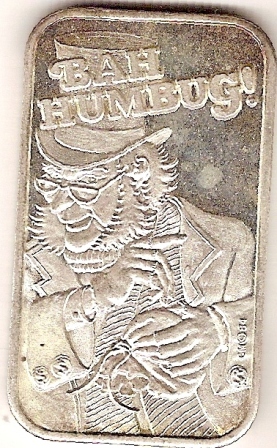
1-ounce silver bar
celebrating
Ebenezer Scrooge

We know retail prices, wholesale prices, and producer prices, salvage value and replacement cost. Many people who are successful traders believe that if they sell you something for $700 and discover later that you would have paid $1000, then they just lost $300. They call it “leaving money on the table.”

This avenue of inquiry was opened for me just over 40 years ago by R. W. “Bill” Bradford when he owned Liberty Coin Service of East Lansing. Soon after the precious metals run-up (or paper money collapse, depending on your view), he retired to Port Townsend where he followed his true calling, publishing Liberty magazine. He always admired H. L. Mencken and saw himself in that role. I was happy to see Liberty on the newsstands next to Reason. Bill passed away too young in 2005. (Wikipedia here.)  I learned a lot in Bill’s coin shop, mostly from the questions he asked. I often could not answer them; and he never did, leaving the work to the student.
 
Plastic tokens from bars and taverns
(US Quarter center for size.)
He asked three rapid-fire questions: “Is a thing worth what you paid for it?  Is it worth what you could sell it to someone else for? Is it worth what it would take to replace it?” 
Collectors pay 60% to 100%
over the spot price of silver
for these common coins.
"The market is always right."

Those were all cogent and obvious, even from my side of the counter. The inherent inflation caused by government deficits was driving up the prices of collectible numismatics which normally would have been insensitive to those markets. When the price of silver went to $50 per ounce because of the Hunt Brothers, coin stores were tossing otherwise “rare” items, such as U.S Mint and Proof sets into shipments bound for smelters. Many collectible silver coins would be replaced at higher prices later, after the collapse of the silver futures market.

PREVIOUSLY ON NECESSARY FACTS

Friday, September 30, 2011

Objectivism and the Gold Standard

Ayn Rand and Alan Greenspan both assumed that the government would be the only source of money.  Even in Atlas Shrugged when John Galt hands Dagny Taggart his own five dollar gold coin it bears the semata of the United States of America.  “On whose authority?” she asks.  “It says right there,” Galt replies.  The absence of private money in Ayn Rand’s capitalist utopia is curious. 

US 1/10 Gold Eagle,
modern US $5,
older US $5
Nothing requires that money be issued by a government, though there is utility in that for that institution.  While gold proved most useful in the industrial age, and may well continue through the information age, historically, gold only served a special function relative to silver.  Historically, silver was the universal metallic money.  Gold, like copper, was a convenience. 

Moreover, a truly agoric coinage would announce only its weight and fineness and not be denominated in money of account.  If by law the “dollar” is 412 ½ grains of silver, then the definition of the dollar can change by law.  Historically, this is well-known.  Debasements are the rule as government expenditures outrun their incomes.  The coinage suffers as their denominations increase. 

On the other hand, it is important to note certain seeming contradictions to Gresham’s Law in the 19th century United States.  Silver half dimes circulated alongside nickel 5-cent coins.  Silver and nickel 3-cent coins also passed equivalently.  When the government changed the weight and fineness of the coins in 1834, it declared that all issues of whatever standard were alike legal tender and it made little difference.

In fact, the first gold coins of the United States did not state their money of account value in dollars until 1807 ($5 half eagle), 1808 ($2½ quarter eagle) and then 1838 ($10 eagle).  They were gold coins, nothing more or less.  Likewise, the British sovereign did not and still does not have a mark of value. 

Size of a half dollar and
potentially more useful.
As a large economic entity – even when limited by a constitution – the federal government of the United States easily should benefit from issuing its own currency, as would General Motors, Microsoft, or you.  There is nothing wrong with government money, but it is not necessarily the only money.  While a gold-backed federal currency would be inherently strong the government has the opportunity to consider and issue a variety of moneys – and historically, it has done so.  Gold and silver, of course, both came from the Mint as did minor and token coins in base metal.  However, through the 19th century and up to the Great Depression, paper promises were backed in gold, and in silver, and in only the credit of the United States.  Some of those unbacked promises paid interest; others did not.  No objective test can show that one kind is “moral” but another not, as long as people have a right to choose. 

But the government does not need to issue its own money.  In 1800 and 1802 republicans in the Senate attempted to shut down the Mint as a drain on the Treasury.  Trade and commerce were carried by foreign coins, largely Spanish dollars and their factions.  Meanwhile, even into the 1830s, merchants along the East Coast kept their books in pounds-shillings-pence, not dollars and cents.  Gold and silver coins from Britain, France, Spain, and Portugal were legal tender until 1857. 

Problems in money and banking generate much discussion among libertarians and objectivists.  Working the Libertarian Party tent at the Ann Arbor Street Fair in 2009, I heard one of my comrades denounce the Federal Reserve and declare that only the government has the right to create money.  Rather than engage in all of that, I offer these links. 
Also here on Necessary Facts:


Sunday, March 27, 2011

Mere Gold is Not Enough: Hayek's "Denationalisation"

F. A. Hayek's Denationalisation of Money (1978) made a case for an open market in money, without legal tender laws, and without a government monopoly in currency.  

Hayek's thesis is two-fold.  First, that a competitive market in money will create currencies that are desirable for their enduring value.  Good money drives bad money from an open market.  Second, more broadly, until we have that happy day, we really cannot say what forms and formats will be acceptable or popular.

Breaking with tradition, Hayek stated that being limited to gold ("the wobbly anchor") is contrary to a truly free market.  Liberated from state control, there is no limit to the forms that money can take.  Hayek even suggested that a truly free market might see stable paper money backed by nothing but the credit of the issuer.  Paper money from one bank might promise payment in the paper of other banks.  Still other possibilities exist. 

It is easy see that if a bank issued too many notes then it would soon be redeeming them as a result of financial reporting. That is history.  For Hayek the more interesting problem was what to do when the market value of a bank's paper exceeds its issue price.
 "... but it could preserve this business only if it did in fact promptly buy at the current rate any of its notes offered to it.  So long as it succeeded in maintaining the real value of its notes, it would never be called upon to buy back more than a fraction of the outstanding circulation.  Probably no would doubt that an art dealer who owns the plates of the engravings of a famous artist could, so long as his works remained in fashion, maintain the market value of these engravings by judiciously selling and buying, even though he could never buy up all the existing prints." (Page 49)
This little book is dense with worthy ideas such as that. Most economists express three uses for money. Hayek defined four: cash purchases; reserves for future purchases; standard of deferred payment; unit of account.

F. A. Hayek apparently had little or no experience with numismatics.  Many of his theoretical claims are supported by facts known to those of us who study the art and science of the forms and uses of money. Other of his theoretical assertions are denied by the facts of history. And to be fair, numismatists, schooled in economics by publicly-funded (or aristocratic) institutions, also err when narrating the history of money.  The idea that coins were invented by merchants to make bullion more convenient for retail trade is the best example of such error.  Charles Seltman, the British numismatist who promoted that silly idea via the Encyclopedia Britannica, never worked behind a retail sales counter.   Similarly,  for all their theoretical knowledge Hayek and the other Austrians had no experience as merchants.

 Hayek says that it is unfortunate that there existed no complete history of the experience of government monopoly on money.  However, he does cite Murray N. Rothbard's monograph, What Has Government Done to Our Money (1963, 1974).  That work is little more than a sketch.  Like Hayek, Rothbard had little involvement with the artifacts.  Rothbard relied on "The Use of Private Tokens for Money in the United States," by B. W. Barnard from The Quarterly Journal of Economics, Vol. 31, No. 4 (Aug., 1917).  That academic paper reported all known issues without regard to their actual use.  Today, Bar Cents and Immune Columbia are regarded as rare and likely saw little use in their time.  Nova Constellatio tokens really did circulate.  In short, Rothbard's data was flawed because he gave weight to an academic paper instead of going to numismatists.  Any active collector of American money could have shown him (and Hayek), the material evidence they sought to support their theories.

"The early Middle Ages may have been a period of deflation that contributed to the economic decline of the whole of Europe. ... But where, as in Northern Italy, trade revived early, we find at once all the little princes vying with one another in diminishing the coin - a process which in spite of some unsuccessful attempts of private merchants to provide a better medium of exchange, lasted throughout the following centuries until Italy came to be described as the worst money and the best writers on money." (page 34)
Yet this complaint - common among historians and cited by gold bugs - ignores one of the arguments for gold-based money: with the quantity fixed by nature, each new invention, import, or innovation caused the existing money to increase in value: hard money is worth ever more over time.  That was the case in the Middle Ages as expanding trade brought more products to market.  It is also true that warlords and generals debased their coins, a common cheat in both Roman and modern times, as well.  But that negative motivation was only part of the story.  Absent new discoveries such as the mines of Joachimstal and the looting of the Americas, deflation is a beneficial consequence of hard money.   Moreover, some strong currencies, such as the English sterling penny and the Venetian gold ducat, enjoyed international reputations.  That meant, however, that they left one place and went to another.  For a local ruler to keep his coins in his realm, the issues had to be useful only locally, otherwise the locale would quickly enjoy an influx of imported goods and a loss of currency.

One solution to that is a token currency. The strength of a monetary medium, itself durable and cheap, but also a token for precious metals that do not pass hand to hand was explored by Neil Carothers in Fractional Money (New York, J. Wiley & Sons, 1930), a book that grew out of his doctoral dissertation some years earlier.  Again this data is a century old.  We know these facts; and they support Hayek's theories.

We can see an analogy to Hayek's laissez faire banking via the stock market.  Common stock certificates are a form of money; and historically their format resembled  bank drafts, being only much larger in size.  Stock certificates were issued, endorsed, transferred, and cancelled.  With or without a declared par value their worth fluctuated on the open market.

Knowing Hayek's theory you are perfectly free to use whatever moneys you prefer.  If you live in the USA, you will find Federal Reserve Notes most liquid.  But all manner of moneys are in circulation here and now, if you only know where to look for them.

ALSO ON NECESSARY FACTS
Numismatics: the Standard of Proof in Economics
Objectivism and the Gold Standard
Money as a Crusoe Concept
Electronic Money: Coins without Realms