Thursday, March 1, 2018

2LT Frances Y. Slanger: American Nightingale

After landing on Utah Beach on D+4, she was killed during an artillery barrage outside Elsenborn, Belgium, on October 21, 1944. Bob Welch delivers the life and death of Army nurse 2LT Frances Y. Slanger by weaving her early life from Lødz and Boston with narratives of World War II. Welch is a master at the craft of writing. Slanger also wanted to be a writer, but always struggled with English. Her incessant scribbling got better and she poured her heart into a letter to Stars and Stripes that was granted the front page by editors who did not know that she was dead.

It is 0200 and I have been lying awake for one hour, listening to the steady, even breathing of the other three nurses in the tent. Thinking about some of the things we had discussed during the day. The rain is beating down on the tent with a torrential force. The wind is on a mad rampage and its main objective seems to be to lift the tent off its poles and fling it about our heads.
The fire is burning low and just a few live coals are on the bottom. With the slow feeding of wood and finally coal, a roaring fire is started. I couldn't help thinking how similar to a human being a fire is; if it is allowed to run down too low and if there is a spark of life left in it, it can be nursed back...So can a human being. It is slow, it is gradual, it is done all the time in these Field Hospitals and other hospitals in the ETO.
We had read several articles in different magazines and papers sent in by grateful GIs, praising the work the nurses around the combat areas. Praising us--for what? I climbed back into my cot. Lt. Bowler was the only one I had awakened. I whispered to her. Lt. Cox and Lt. Powers slept on. Fine nurses and great girls to live with...of course, like in all families, an occasional quarrel, but these were quickly forgotten.
I'm writing this by flashlight. In this light it looks something like a "dive". In the center of the tent are two poles, one part chimney, the other a plain tent pole. Kindling wood lies in disorderly confusion the ground.. We don't have a tarp on the ground. A French wine pitcher, filled with water stands by. The GIs say we rough it. We in our little tent can't see it. True, we are set up in tents, sleep on cots and are subject to the temperament of the weather.
We wade ankle deep in mud. You have to lie in it. We are restricted to our immediate area, a cow pasture or hay field, but then, who is not restricted? We have a stove and coal. We even have a laundry line in the tent. Our GI drawers are at this moment doing the dance of the pants, what with the wind howling, the tent waving precariously, the rain beating dow, the guns firing and me with a flashlight writing. It all adds up to a feeling of unrealness.
Sure, we rough it, but in comparison to the way you men are taking it, we can't complain, nor do we feel that bouquets are due us. But you, the men behind the guns, the men driving our tanks, flying our planes, sailing our ships, building bridges and to the men who pave the way and to the men who are left behind--it is to you we doff our helmets. To every GI wearing the American uniform, for you we have the greatest admiration and respect.
Yes, this time we are handing out the bouquets...but after taking care of some of your buddies; seeing them when they are brought in bloody, dirty, with the earth, mud and grime, and most of them so tired.  Somebody's brothers, somebody's fathers and somebody's sons. Seeing them gradually brought back to life, to consciousness and to see their lips separate into a grin when they first welcome you. Usually they kid, hurt as they are. It doesn't amaze us to hear one of them say, 'How'ya, Babe' or 'Holy Mackerel, an American woman!' or most indiscreetly, 'Howabout a kiss?'
These soldiers stay with us but for a short time, from 10 days to possibly two weeks. We have learned a great deal about our American soldier, and the stuff he is made of. The wounded do not cry. Their buddies come first. The patience and determination they show, the courage and fortitude they have is sometimes awesome to behold. It is we who are proud to be here. Rough it? no. It is a privilege to be able to receive you, and a great distinction to see you open your eyes and with that swell American grin say, “Hi-ya babe!”—Stars and Stripes, November 7, 1944.

The story came to Bob Welch in December 2000 when he was a columnist for the Register-Guard in Eugene, Oregon. A reader had found a short biography of Slanger and asked Welch to pursue her story. He did. He got a call from Eugene resident Sallylou Cummings who had served with Slanger. She was then 82. The Greatest Generation was slipping away and Welch made one of the last grasps for it. He succeeded admirably.

Bob Welch has written nine books, spanning an impressive range of genres. Among them, listed and summarized for sale on his website (http://bobwelch.net/) are :
  • The Keyboard Kitten: Gets Oregonized
  • 52 Little Lessons from It’s a Wonderful Life
  • Resolve: From the Jungles of WWII Bataan, the Epic Story of a Soldier, a Flag, and a Promise Kept
  • Cascade Summer

Welch's biography of Frances Y. Slanger is both warm and objective. He brings her to life. She was an otherwise small person who had one great moment. Ultimately, we all are or Shelley would not have written “Ozymandias.” But Frances Slanger was also an individual representative sample from the self-generating process that is America. Not only has that system generated its own power, it generates selves. Born Freidel Yachet Schlanger, she remade herself according to an inner image that too few others in her life shared. Parents, teachers, and hospital supervisors were ignorant of her powerful potential energy. Welch found it. 

 Just as a chance encounter brought Slanger's story to Welch, so, too, did I find it in a minor reference about World War II. As a numismatist, I have some interest in Military Payment Certificates, part of a better developed curiosity about how people create and use money. Soldiering is life at the extremes. I subscribe to an occasional email list, the MPC Gram, written mostly by Fred Schwan, who with Joseph Boling, compiled the definitive guide to American military money of World War II. Schwan mentioned finding American Nightingale at a militaria show outside Toledo, Ohio. I requested the book from our city library and picked it up at my neighborhood branch. 
  • World War II Remembered: History in Your Hands, a Numismatic Study by C. Frederick Schwan and Joseph E. Boling, BNR Press, 1995. 864 pages.
  • Comprehensive Catalog of Military Payment Certificates by Fred Schwan, BNR Press, 2002. 400 pages.

An official history of 2LT Frances Y. Slanger here:
Another review here:

PREVIOUSLY ON NECESSARY FACTS

Saturday, February 3, 2018

Electrum and the Invention of Coinage

The book was typeset in sentences. The result is a disjointed narrative, a series of unattributed assertions and contradictory generalities. Despite those and many other problems with the text and narrative, the work was intended primarily as “a comprehensive handbook on the origins of coinage.” As such, its best feature is the presentation of 179 coins organized chronologically, geographically, and by size. Overall, the book would have been greatly improved by professional editorial management.


I believe that the author made note cards from the reference books he relied on and then wrote the narrative after sorting the cards more or less by main subject. Maybe he just wrote it all off the top of his head. However it was built, the lack of craftsmanship is painfully obvious. “Gold is immutable, Electrum has the appearance of gold. The first coins were made of Electrum.” (page 9). “The use of gold and silver coinage quickly spread throughout the known world, with City-States such as Kyzikos, Phokaia and Mytilene minting Electrum trade coinages with great success.” (page 74)

Electrum and the Invention of Coinage
by Joseph Linzalone
(Dennis McMilllan Publications, 2011),
 xv + 232 pages, color illustrations,
24x15 cm (9-1/2 x 6 in), $80.
Capitalization is Germanic. “Electrum, Silver, Bronze, Copper and other metals all have been highly esteemed and valued.” (page 1) … “One Talent equaled 60 Minas. A Mina was worth 60 Shekels.” (page 3) … “An Eighth Stater of Erythrae, 1.77 g., with a Floral pattern round with pellets with a reverse of a shallow square punch is published as Sear, Greek Coins and their Values, #3462.” (page 127). The lack of italics for the title of the book is typical of other typesetting problems. Oddly enough, although the foundation of the bibliography consists of German titles, the u in Münze has no umlaut, though Muenze would have been acceptable.

The invention of coinage is a singular problem. It is easy to project ourselves on the past and assume that they were initially intended to be money and were created as a medium of indirect barter to facilitate economic calculation. Over the past 150 years, scholars have attempted half a dozen theories to explain the creation of coinage. In 1869 Ernst Curtius put forward a "religious" theory, since the word "money" stems from the temple of Juno Moneta. That these earliest known proto-coins and coins are definitely associated with the Temple of Artemis at Ephesus, which was excavated 40 years later, could substantiate that. Payment of mercenaries, specifically, as opposed to general commerce was the theory put forward by Robert M. Cook in 1958 ("Speculations on the Origins of Coinage," Historiav11 1958, 257-262.)  Philip Grierson looked to the administrative needs of the early Greek city-states (Origins of Money 1970, 1976). Following Cook, Martin J. Price underscored the fact that these first coins were worth more than anything you could buy with them, and therefore, they were probably given to mercenaries as honor awards. (See "Thoughts on the Beginnings of Coinage" in Studies in Numismatic Method Presented to Philip Grierson, Cambridge, 1983). Given the intellectual ferment of archaic Hellas, those theories might all be true in some array of close context, but none of that is in this book. Linzalone cites Aristotle and Plato who posited the need for a medium of indirect barter to facilitate commerce and leaves it at that.

The author does indeed acknowledge the consequences of the commercial revolution associated with the introduction of coinage. The event coincides with the rise of democracy, as well as the birth of philosophy, formal geometry, the ascent of a mercantile class, and the mercenary army. But understanding the place of coinage in that context requires teasing out those threads, which the author never does. He merely repeats that coins (beginning with unmarked proto-coins) were money.

The author also projects into the past our atomic theory of matter. The first abstract conception of “elements”—earth, water, air, fire—came from Empedocles of Akragas c. 500 BCE. But it was not developed further until the Enlightenment and it was still argued into the 1800s, even as the periodic table was being worked out. The author misses the fact that electrum, silver, and gold were three distinct metals, as were copper, tin, and bronze. Demokritos of Abdera and others notwithstanding, lacking an atomic theory of matter, the ancients had no other way to understand electrum but to accept it as a metal in its own right, naturally occurring but capable of manufacture.

The primary strength of this work is the catalog of 179 images of proto-coins and coins, organized geographically and sorted by size. Each listing includes the weight in grams to two decimal places. Coin 1001 is an archaic proto-coin stater of Samos 17.65 grams and 17.5 mm in diameter. In every case that diameter is always the major axis of the ellipse. And most of these objects are elliptical, not the least of which is the famous Phanes coins of Ephesus. However, all of these images are reproduced at twice actual size. So, comparisons are easy. Moreover, modern technology allows the user to blow these images up even more before pixiliation and the loss of resolution. Unfortunately, except in the cases where the images were borrowed from the owners, no attributions or provenances are given; and the ones that are, give only the last auction house by name, not by sale and lot number.

In response to a request for an interview via email, Joe Linzalone wrote (verbatim): It is a hand book filled with useful facts and information about the coinage and the issuers. Focusing thus I did not maintain a narrative story-teller stance. The book was written on request off my colleagues, in that I am the foremost dealer in Electrum, with 41 years experience. I was asked to write that my expertise would not be lost when gone.” According to Worldcat.org, the book is shelved at 14 libraries including the Library of Congress, the University of Oxford, and the University of Queensland. There, and on the shelves of private numismatists, this “comprehensive handbook” will serve as best it can.


PREVIOUSLY ON NECESSARY FACTS

Tuesday, January 30, 2018

Team of Teams

Team of Teams: New Rules of Engagement for an Empowered World by Gen. Stanley McChrystal (US Army, Ret). With Tatum Collins, David Silverman, and Chris Fussell.  
Portfolio/Penguin, 2015.


An enjoyable, erudite read, Team of Teams by Stanley McChrystal was written by a general for generals. McChrystal takes his time to make his points. He presents cogent evidence to support his assertions, but those would be easy enough to accept on the basis of his authority. His education and experience made him an expert.  From 2003-2008 he was in charge of the Joint Special Operations Command that was responsible for defeating the insurgency of Al Qaeda in Iraq (AQI), and neutralizing its leadership, including the death of Abu Musab al-Zarqawi. In order to achieve that, McChrystal had to reconfigure the way the Army usually operated.

The transformation was radical for the military, but familiar to the private sector. Information could not be held in organizational “silos” on a need-to-know basis. The office layout, while allowing adequate personal space, had to be open so that people could talk across desks, across islands of information and authority. This was only way that the allied joint forces could defeat AQI, which was decentralized, resilient, adaptable, flexible, and driven by the media of information exchange from the cellphone to the international news website.

The coordinating theme is the balance and integration of shared consciousness and empowered execution. Shared consciousness includes the physical perceptions brought in from information assets, either directly from soldiers in the field or indirectly from informants or remote sensors. It also includes the philosophy of the mission, an agreement on doctrine and rules of engagement. Given that, empowered execution allows those closest to a problem – taking a house or killing an enemy leader—to solve it in real time.

Early on, McChrystal establishes a baseline that he returns to repeatedly throughout the book. Frederick Winslow Taylor’s efficient organization defined not just the methods of production or the layout of the office, but the fundamental doctrinal premise of a civilization for 100 years.  Taylorist thinking led to the impenetrable (but immovable) Maginot Line that aircraft flew over. The coalition forces defeated Saddam Hussein because both sides were fighting the previous war. The Iraqi insurgency demanded new habits from new learning. It was time to take everyone’s brains out of their footlockers and put them all to work thinking, discussing, planning, and criticizing.

Chapter 10 “Hands off” contrasts the experiences of Commodore Matthew Perry and Gen. Ulysses Grant. Perry was on his own, over 6,000 miles from home. He had total control and no oversight. On the other hand, Grant issued meticulously detailed orders to his generals. McChrystal’s world was a strange mix of the two. While he enjoyed complete information input from assets in the field, soldiers, helicopters, and drones, he also insisted on letting the leaders on the ground make their own decisions, knowing, of course, that they were not alone at all. 
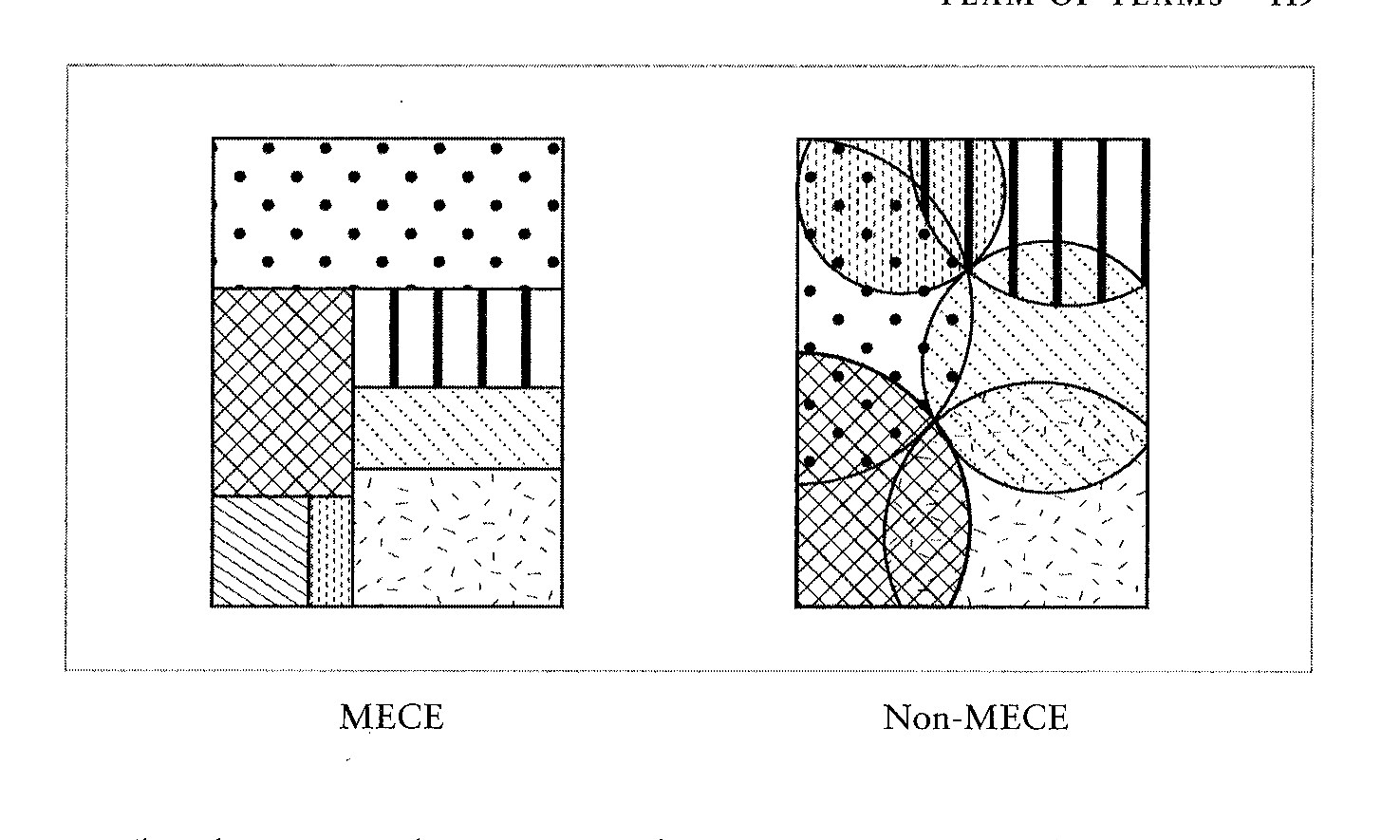
MECE: Mutually Exclusive and Collectively Exhaustive

McChrystal completed a master of science in International Relations from Salve Regina University. He has company. Maj. Gen. James W. Nuttall deputy director of the Army National Guard earned an MA at SRU. Gen. Peter Chiarelli completed an MA in national security strategy at SRU after earning an MPA from the University of Washington. After finishing a master's at Salve Regina, Gen. Anthony Zinni (USMC) earned another master's from Central Michigan University.

Perhaps making too much of his outside-the-box thinking, it is interesting to note that Gen. McChrystal recommended A Connecticut Yankee in King Arthur’s Court for Admiral Stavridis’s anthology, The Leader’s Bookshelf. Also, whether and to what extent such new age intuitions actually instantiated the doctrine of counter-insurgency outlined by David Galula may be putative. It may be that victory in Iraq such as it was came from doing what soldiers always do and that so-called “counter-insurgency” ultimately proved to be a failure because it could never have been a success. 


PREVIOUSLY ON NECESSARY FACTS