Saturday, November 26, 2016

Star Trek: (Not too Far) Beyond

It was all right as such things go. I know from numismatics that the coins we cherish today – Bust Half Dollar, Peace Dollar, Walking Liberty Half Dollar – were reviled in their own time. Shakespeare and Bach were lost and then re-discovered in the 19th century.  So, perhaps time will serve this movie well. For the present, Wikipedia quoted Richard Roeper of the Chicago Sun-Times (July 18, 2016): “[e]ven with its big-screen pyrotechnics and its feature-length running time, Star Trek Beyond plays like an extended version of one of the better episodes from the original series, and I mean that in the best possible way.”

Like much television writing, this plot had problems.  To be fair, we watched it twice. Between times, I read Wikipedia and Memory Alpha to understand what was happening. Perhaps I am getting old, but a lot flashed by at warp speed the first time, and I missed some details. Nonetheless, the second viewing after all of the reading revealed unsolved problems with the plot.

The only surprise was that the movie ran 122 minutes. It felt like three hours. All of the elements of a Star Trek story were in place, but nothing more. We do not learn anything new about our virtual friends or their universe.  The star base Yorktown was visually compelling, but we have seen its like from Coruscant of Star Wars, if not Earth of The Jetsons. 

Captain Kirk’s closet.  He has a rack of identical uniforms. I have two uniforms. It is hard to imagine how he gets dirty during his working day. And the ship must have some kind of laundry, even if replicators were not yet invented in this timeline.  I get the point: life is monotonous; even his wardrobe is boring. Still, he must have had work clothes, work-out clothes, and a formal.

Why did Dr. McCoy go into Chekov’s locker?  That seems like a gross violation of personal liberty, even on a military vessel. It is not clear that alcohol (or anything else like it) is forbidden on board. Presumably, of course, one cannot report for duty incapable of performing as required. But Saurian brandy and other references are known from the Original Series. In By Any Other Name, Scotty gets the Kelvan, Tomar, drunk. “What is it?” the alien asks.  “It’s green,” Scotty replies. For the Next Generation, we had a bartender mixing amusing concoctions.

Nietzschean Philosophy. Krall (formerly Captain Balthazar Edison of the Franklin) launched his vicious attack in defiance of the unity and peace of the Federation. Humanity needs the struggle of war to advance, he claims. So, he acquires a powerful bioweapon in order to destroy millions (perhaps billions) of people thereby giving the survivors something to live for. That twisted logic is familiar from 50 years of James Bond villains, but probably has roots in Jules Verne’s Captain Nemo and Robur the Conqueror.  

Minions. Where does Krall get his crew from? Were these the other survivors of the Franklin? He throws them away easily enough. That callous disregard for his minions must have been evident to them decades earlier. If they agree with his philosophy, why have they not fractured into 50 warring kingdoms with hordes of battling robots, rather than being unified under Krall’s (questionable) leadership? (This is the same problem from Space Seed and the story of Noonian Singh Khan.) Why had they not reduced their numbers, as they sucked the life out of each other over 100 years.  

Zombies/Vampires. These beings from the Franklin can only extend their lives by sucking the life force of other beings.  It seems like thin fare, as seldom as the nebula has been visited.  Krall and his minions must be constantly on the hunt.  Also, while Jaylah is clever enough to have survived, her origin is not clear. (I fell from the sky.) Neither is it clear where the other scavengers came from, or how they survive, again, given Krall’s powerful army of zombies and robots. (Perhaps they were living on bats and moths, the only animals on the planet, apparently.)

The Reputation of the Nebula. Given that it harbors an army of vampires or zombies, supported by a huge army of robots, the nebula should be infamous as a place to avoid.

Magellan Probes. The point above is underscored by the reference to the Magellan probes. The Federation has been exploring the nebula for some time. The mysterious disappearance of the Franklin must have been a warning, as would be the unsuccessful series of probes. The reference to the Magellan probes also contradicts Kirk’s warning that they are entering a nebula that will make communication with the Federation impossible.  The probes were expected to work.

Captain Edison’s Complaint.  Krall/Edison’s grudge against peace and quiet is reinforced in his own mind by his allegation that the Federation “abandoned” him. But he must have known that communication outside the nebula was difficult or impossible until he himself was able to “piggyback” Magellan probes to establish a read-only traffic from the Federation.

The Beastie Boys.  As annoying as that so-called music is, it is, nonetheless music with complex patterns. It is no worse than Klingon opera. Work as it did against the robots, it failed to affect Krall’s ship.
 
from http://www.dafont.com/federation-classic.font
Found all over the Alpha Quadrant.
No telling where it originated.
The Writing on the Wall.  Finding a single inscription on a wall in a cave, McCoy and Spock leap to the conclusion that the Abronath artifact originated from this planet (Altamid) because the writing is similar.  When I first was attracted to numismatics, it occurred to me that a time traveler to Pax Romana could freely spend Mercury dimes. Hopefully, no one today looking at one of them thinks that they came from ancient Rome.


On the Up Side.  The stone in the necklace that Spock gave to Uhura was named “vokaya” by the founders of Memory Alpha,  Daniel C. Carlson and Harry Doddema. “Doddema thought of trinitite, a real radioactive material created by the Trinity atom bomb test that was used in jewelry before its effects were understood. Such radioactive materials would have been created on Vulcan in the nuclear wars before the Time of Awakening. Studying the Vulcan language, they settled on the name "Vokaya" as a contraction of Vokau-heya, meaning "remembrance stone" or "memory stone", as the Vulcans would use vokaya to remember how warlike they were.” (Memory Alpha here.) 

PREVIOUSLY ON NECESSARY FACTS.

Monday, November 21, 2016

FOND Bone Broth

Not only is Fond Bone Broth good for you, being shelf stable for one year, it makes an excellent gift.  

On their website (here) they say that they took the name FOND because it is French for "base" or "foundation."  They do not say that the word "restaurant" comes from "restore." Following the disastrous policies of Louis XIV and his interventionist minister Jean-Baptiste Colbert, the middle class of Paris was starving amid plenty. The French cuisine we treat ourselves to now was designed to puff up severely limited resources with air.  Those who could afford it went to "restaurants" where they were restored with strong broths and other good foods from whole ingredients.  FOND broths follow in that tradition. 
I met Michal from FOND Bone Broth
of New Braunfels, Texas,
at the Wheatsville Co-op on South Lamar.
 

You could make this yourself. My wife, Laurel, does. It takes her two days. She has the time because she works from home.  Most people do not have two days to cook the bones of happy free-ranging animals along with organic herbs and spices.  

And then there is the retail price. It is less than $15 per pint. ($154 for a case of 12.) That sounds like a lot if your head is still in 2008.

I had a couple of graduate classes in economics during the Bush-Obama Wall Street Bailouts. One of my professors, Steven Hayworth, was a good Marxist. He knew his stuff; and he was intellectually honest.  He put up a graph of the infusion of cash into the banking system. (He said $3 trillion. It was more like $4 trillion.  See Forbes magazine here. ) Prof. Hayworth asked, "What will happen to prices?"  No one said anything.  With two index fingers, he pointed to me up front and my conservative comrade in the back. "You tell them," he said.  "Prices are going to triple," we said.  Prices have not tripled over night because banks have been storing the imaginary money, eking it out slowly so as not to trigger public panic.  Prices today are only about 40% higher than they were a decade ago. The true cost of nutritious food has gone up while fast food chains sell "salads" of iceberg lettuce for the price of meat.
Biodegradable packing from corn starch.
Fond Bone Broth has a Kickstarter campaign (here)
"A short cut tastes like a short cut, so we don't take any. We start with local farms, and carefully tended backyard gardens whenever possible. Then using traditional french cooking methods, and a lime-twist of modern mixology we arrive at our FOND™ signature flavors perfect for sipping or for use in your every day cooking."

PREVIOUSLY ON NECESSARY FACTS
Sunday at the Co-op
Hail Merry Desserts
Shannon Beer of Keller, Texas
Great Bean Chocolate

Sunday, November 20, 2016

Spoken American Grammar

"If he was to go to the White House..."  
"A group of men were on their way..."

Languages change. We know that.  Years ago, working for yet another software development firm, I asked the engineers to write up management summaries of their parts of this project. One of them turned in work that was below high school level.  I went to his office and asked him about it.  "You write in a computer language," I said. "It has grammar, syntax, and vocabulary.  How can you not write well in your native language?"  He replied that in his mind, he was not writing sentences, but stringing connections on pulleys.  He built machines with computer code as his "Erector Set."  A few days later, he came into my office.  "Languages change," he said.  I agreed, of course.  "So, how does this happen?  Do academics and professors get together and write new rule books for us to follow?"  Of course not, I admitted. Languages change and somewhere along the way, it is noted and rules are amended. "So," he replied, pressing his point, "if you follow the manual, you are not using the current version."

Our local NPR affiliate (KUT-FM), also carries the BBC World News.  I heard a collective noun used as a plural: "The team were traveling to ..."  I perceived that as an older construction, not a modernism.

It is an interesting generalization that so-called "primitive" languages have more complicated grammars than the languages of civilized peoples.  In The Right Stuff, Tom Wolfe noted that Chuck Yeager sometimes fell into an archaic verb form of "helped" as "holped."  We have three tenses now with "help" as a weak verb: help, helped, has helped. In Anglo-Saxon and Old German, it was: help, halp, holpt, yholpen.  

When I was in the first grade, one of my classmates, newly arrived in Cleveland from West Virginia, always began sentences with consonants even when reading: "Hit is a dog. See the dog." Later, at the College of Charleston, my professor of German, a philologist, identified that as another archaism.  Some years later, working in Cleveland, a Slovenian colleague said that European Slovenians find American and Argentinian Slovenians speaking with rural forms no longer heard back home.

Another change, brought into common American by African-American urbanites is the strong past tense.  "I had gone to the store." for "I went to the store."  

I believe that the reflexive is also fading.  "I did it for me." rather than "I did it for myself." 

Maybe I just notice these because I heart languages.  I believe that the fundamental purpose of language is to enable thinking.  Communication with others is a secondary consequence.  It is true that human language evolved from animal calls. However, that is in our past, and for about 5000 years, self-awareness has been the primary function of modern language.

ALSO ON NECESSARY FACTS

Thursday, November 10, 2016

Still Riding the Gray Planet

Conflict, combat, even war in outer space against the Russians always seemed like a real possibility and may yet come to pass.  That big spinning wheel of a space station might be built.  The asteroid belt probably does contain a plethora of rocks worth fighting for. In my mind, I was about 10 when I first read this book, but the bibliography shows that I was closer to 15.
  • Rip Foster in Ride the Gray Planet by Blake Savage, Western Press, 1952
  • Assignment in Space with Rip Foster by Blake Savage, Whitman Publishing, 1965
  • Rip Foster in Ride the Gray Planet by Blake Savage, Western Golden Griffon, 1969

First Edition
In the narrative, the astronomy and physics are explained, but with World War II still close in the past, and the Cold War and the Korean police action in the news, the military details required no spoken footnotes.  That said, it was only during my re-reading last week that I actually perceived the Special Operations Squadron soldiers as a platoon: lieutenant, sergeant major, two corporals, and six privates. I still needed Wikipedia to place the friction between “Planeteers” and “Spacemen” in its proper context. It was easy enough to accept that different branches of the armed forces hold themselves in highest regard. That this was “Marines” versus “Navy” should have been obvious to me.  The Planeteers follow Major Joe Barris, but the Spaceman obey Commander Kevin O’Brine.

Lieutenant Richard Ingalls Peter “Rip” Foster has just graduated from his academy aboard a space station. Expecting to go home on leave, he is re-deployed to the asteroid belt to retrieve a large rock (about a mile across) of pure thorium.  By the same process that he picks up a “spack” (space pack) of gear from a supply room, he picks up his team:

SGM Koa - Hawaii USA
CPL Nels Pederson - Sweden
CPL Paulo Santos - Philippines
PVT Kemp - USA
PVT Dowst - USA
PVT Bradshaw - UK
PVT Trudeau - France
PVT Dominico - Italy
PVT Nunez (not Nuñez or Portuguese Nunes) - Brazil.

They serve the Federation of Free Governments.  The bad guys come from the Consolidated Peoples’ Governments: the Connies. The good guys are Feds.  
NASA Exchange KSC 12/98

The narrative and dialog is rich with jargon. Space itself is personified as Old Man Nothing and Old Man Cosmos.  Surprised or angry, they exclaim, “Great cosmos!” and “By Gemini.” The command to hurry is “Show an exhaust!”  “High vack” can be a verb: He high vacked into the control room, i.e., he hurried. But the high vacuum of space is also a noun: “let high vack into the space suit”.  Too much time in outer space can leave you “vack wacky.”  The origin of “son of a space sausage” must remain unexamined.  They call sick bay the “wound ward.” Ships had sick bays before spaceships had them, of course, but it nonetheless seemed to me to reveal the extent to which the vocabulary of Star Trek became common English.

Sidney, Ohio, 9/99
The Planeteer force – Special Operations Squadron – depends on a huge body of volunteers to wash out. Every boy in the free world must want to join. (In one scene, a Planeteer quips that the Spacemen are the ones who failed.)  According to the narrative, 15 of 100 applicants make it to the Planeteer Academy. After two years they become privates.  While they study science, exploration, colonization, and fighting, ten of those 15 make the next cut.  Finally, only 1 of 500 applicants earns the orbital insignia of an officer. Officers study astrogation, navigation (which seems redundant), and a specialty field.  LT Rip Foster specialized in astrophysics. In real life, astrophysics can be orbit plotting, but even in 1952, it was largely the study of the energy cycles of stars.

Austin, 8/16
As for the physics, most of the book was acceptable for working in low gravity.  However, the Planeteers carry old-fashioned side arms, which they never used (gratefully).  Their weapons were small rockets (at a distance) or knives (close order).  To work on the asteroid, they had no special reactionless tools. They did anchor each other to an outcropping to drive a spike, but then they  screwed the spike into the rock with no allowance for torque and conservation of energy. Egregiously, they tethered a block of thorium with a towline and tugged it to the cruiser with a space boat. Apparently, the rock did not slam into the ship, but stopped politely of its own volition.

Rip Foster’s adventure is a small part of the common culture. You can find a stub in Wikipedia here and also a biography of Harold Goodwin who wrote as “Blake Savage” here

Two versions are archived on Gutenberg:
Rip Foster in Ride the Gray Planet by Harold L. Goodwin
and
Rip Foster Rides the Gray Planet by Harold L. Goodwin

Previously on Necessary Facts

Sunday, October 30, 2016

The Living Fish Swims Under the Water

My Google email account associated with this blog is uszik11@gmail.com.  It is a pun. I took USZIK ELEVEN from what is supposed to be one phrase mutually intelligible in Finnish, Estonian, and Hungarian.  “The living fish swims under water.” You can google the phrase for articles dedicated to it.
ISO map of the Uralic languages from Wikipedia

The proposition was offered by Mall Hellam, a scholar from Estonia who has taken on a fight for the cultural traditions of ethnic minorities within western Siberia. In those lands, native peoples speak languages that are similar to Hungarian, Finnish, and Estonian.  Over the years, I acquired books and articles about the languages of the Ostyak, Vogul, and others.  I recognized words that I learned in Hungarian, such as “kutya” for dog. 
  • Estonian: 'Elav kala ujub vee all
  • Finnish: 'Elävä kala ui veden alla.
  • Hungarian: 'Eleven hal úszik a víz alatt.
  • English: A live fish is swimming underwater.
"Linguistic roots common to both branches of the traditional Finno-Ugric language tree (Finno-Permic and Ugric) are distant. About 200 words with common roots in all main Finno-Ugric languages have been identified by philologists including 55 about fishing …" 
Wikipedia here: https://en.wikipedia.org/wiki/Finno-Ugric_languages

“The Dying Fish Swims in the Water” in The Economist here: http://www.economist.com/node/5323735
(Article is about the suppression by the Russian central authorities of native cultures in northwestern Siberia .)

Wikipedia articles
Ural-Altaic Languages

Uralic Languages

Finno-Ugric Languages

Mall Hellam “European of the Year” here:

Mall Hellam and Human Rights here:
Mall Hellam biography (in Estonian) here:
(The Latin words “Information” and “Institute” are easy to spot. The Finns and Estonians must have had some contact with the Czechs in the distant past, and apparently stole all the vowels from the Czech   language and brought them back to the Baltic lands.)

PREVIOUSLY ON NECESSARY FACTS

Thursday, October 27, 2016

Why Do Young Women Growl?

If you listen to young women, about age 35 and below, you will notice that they growl.  They also end every sentence and many phrases with an uplifting question tone.  The two mannerisms combine to deliver a distinctly female way of talking that is also demarcated by age. Whatever their other sins, Sarah Palin and Elizabeth Warren do not growl.

You can hear this on the radio, especially news radio, and most especially on public radio.  I do not know that this affectation is a cultural consequence of progressivism.  But that is where I hear it because that is what I listen to on the radio.  We have a Fox radio affiliate here in Austin, KLBJ-AM/FM, but the only deejays I hear there are middle aged white men.  And I do believe that this does cross ethnic lines: from certainly some to perhaps many young Black women who are college educated also mimic this linguistic artifact.

I noticed this first perhaps five years ago.  But thinking back, I suspect that this began in California with the “Valley Girls” of the 1970s.  I finally decided to log a few convenience samplings for my citations. We have several non-profit radio stations here in Austin, and our NPR affliate is KUT-FM.

KUT Kate McKee
“Why Don’t Austin Community College Trustees Represent Specific Districts?”
(October 20, 2016)

KUT  Audrey McGlinchy
(Audrey is from Brooklyn, NY)

KUT Ashley Lopez
“What Mexico Can Teach Texas About Birth Control”
http://kut.org/post/what-mexico-can-teach-texas-about-birth-control

NPR All Things Considered
Melissa Block
“Going for the Gold…”
(September 8, 2016)
http://www.npr.org/sections/thetorch/2016/09/08/493111873/after-going-for-gold-athletes-can-feel-the-post-olympic-blues
What is interesting here is that the first two women that she interviews also growl.

NPR Rae Ellen Bichell

NPR Here and Now
Sarah Cliff

Perhaps the best offender I found right away is Alyssa Rosenberg  of the Washington Post. She was interviewed for her series “IN POP CULTURE, THERE ARE NO BAD POLICE SHOOTINGS:  DRAGNETS, DIRTY HARRYS AND DYING HARD: PART III” which was published on Wednesday, October 26, 2016, and for which she was interviewed on NPR’s “All Things Considered” Thursday, October 27, 2016, by Kelly McEvers. McEvers also growls, but Rosenberg is deep into it. Here: http://www.npr.org/2016/10/27/499637421/washington-post-reporter-explores-how-pop-culture-influences-views-of-police

In this last example, the interviewer, McEvers, growls in a more typical fashion, at the end of sentences or at the end of significant clauses within sentences.

I could suggest several origins.  For one thing, we all project tentative, unproven beliefs. “I think, like, maybe, there is no God?, in the traditional sense?, but there might be a Higher Power? out there on, like, a higher metaphysical? plane.”  That just begs for growling and upward tones.  Valley Girls of the 1970s would have been unsure about homework but certain about make-up and clothing, like ya know what I mean?

Regardless of the etiology of this linguistic disease – if it is that and not a mutation? with survival benefits?—it remains a cultural artifact.  I first learned of this studying Japanese.  (I had two college classes in "Japanese for Business" before working for Kawasaki and Honda.)  Japanese women speak in different tones than Japanese men. They also have different words for the same things.  I understand that this phenomenon of gender differentiation in active language is not limited to the Japanese, only that I learned of it while studying their language and culture.

ALSO ON NECESSARY FACTS

Saturday, October 22, 2016

AKKADIAN ROOTS OF MODERN SEMITIC LANGUAGES

Dated at 2360 BCE, Sargon of Akkad eclipsed the Sumerian kingdoms along the Tigris and Euphrates. In Akkadian SALIMUM ALLAKUM means “peace will come.” Today, even among Turkic peoples of central Asia, the common Arabic greeting has been adopted into the local culture as one word: SALOMALEIKUM–“peace be upon you.”  It is nearly the same in Kyrgyzstan, the first western neighbor of China: ASALAMU ALEYKUM (two words).  But those are not native to those Turkic people, either.  They inherited them when they adopted the Muslim religion of the Arabs, who were and are Semitic. 
 
A Grammar of Akkadian (Second Edition)
by John Huehnergard, Einsenbruns, 2005.
The word for “seven” in Akkadian is SEBE.  It has not changed much in over 4000 years. The Indo-Europeans found it convenient. The word “number” comes from “name-bearer” and these early peoples, Semitic and Indo-European, shared a margin where the Hittites met the Akkadians. The earlier Sumerians had their own merchant colonies within Hittite cities and it was the Sumerians who invented the naming of quantities.  Everyone else stopped with “one, two, many.” When the Akkadians conquered Sumeria, they adopted the cuneiform script and much else that went with it.  The Akkadians borrowed words from the Sumerians, also a common occurrence, among them those for Crown, Palace, and Scribe. 

Dog was KALBUM like the modern “Caleb” a man’s name in the Bible or “kalib” in modern Arabic. 

House was BITUM like the later root “beth” as in Bethlehem or Elizabeth. It is seen the second letter of our alphabet: Beta from the Phoenician letter which was a pictograph of a house.  Their letters were called Ox, House, Camel, Delta, … as in modern Hebrew:  Aleph, Beth, Gimel, Daleth.

The common Arabic man’s name HABIB (beloved) is found in the Akkadian word KABTUM.  Like the Indo-European languages, the Semitic have a tie from the aspirated Ha to the harsher (velar) Ka. We see it in Latin, Spanish and Italian CARA which are the English WHORE and German HURE with French in the middle with CHER.  K-H is also found in words common to Finnish and Hungarian. 

PREVIOUSLY ON NECESSARY FACTS

Tuesday, October 18, 2016

A Moment of Science Fact as Science Fiction

The picture that appeared on Reuters.com was startling familiar.  "My god! Someone built the Time Tunnel!" I thought.  But, it was actually the shrinking machine from Fantastic Voyage that NASA did not build.  What they did announce was preparations for the James Webb space telescope.  And congratulations are appropriate.

Submarine about to be shrunk and injected into a patient.
Isaac Asimov's novel was made into a movie (1966) starring
Sophia Loren, Donald Pleasance, and Edmund O'Brien.
James Webb space telescope being prepared.
Video from NASA on Reuters here.

Previously on Necessary Facts
Fantastic Voyages: teaching science with science fiction
Monsters from the Id: Science is Mankind's Last Hope
From Texas to the Moon with John Leonard Riddell
Great Scientific Experiments

Sunday, October 9, 2016

Shannon Beer of Keller, Texas

The Shannon Brewing Company’s local representative, Sam McClelland, was at the Guadalupe store of Wheatsville Co-op here in Austin last Friday.  I met him as I stopped in to get food for the long drive home down Lamar Avenue. (I had other shopping to do that took me off route. And Austin City Limits Live was enjoying their second weekend this year; so, traffic was worse than usual.) A couple of sips of good beer helped, also.
  
 Shannon Brewing Company is two years old.  Sam said that they have been popular in Dallas and are now branching out across Texas.  I think that they will do well. When I moved here in 2o11, I was not impressed with the beers.  The Prohibition Wars were fought in Chicago, not Houston, for a reason. In the five years since, I have found quite a few worthy brews and Shannon is one of the best. 

I tasted their Irish Red and Honey Porter.  The Red was flavorful, not hoppy, with a light grainy aftertaste.  The Honey Porter was surprisingly light and also not cloying the way other honey brews can be. 

On their websitethey say:
Lets face it, beer is mostly water so brewing with the purest, best-tasting water we can find is a pretty good starting point. Shannon Brewing Company shares 20 acres of land with Samantha Springs, a natural source of exceptional drinking water. We secured the rights to brew our beer with pure Samantha Springs water — straight from the spring, through our filtering system, right into our brewing tanks — no chlorine, fluoride or any other treatments…just pure spring water.

At Shannon Brewing, we prefer two-row barley — the plumper, sweeter and usually more expensive version, which brings a full-bodied sweetness to the beer. It also provides a larger and stronger husk that is imperative to our natural filtration methodology. We will never compromise great flavor to save a few dollars. --http://shannonbrewing.com/ingredients/

PREVIOUSLY ON NECESSARY FACTS

Friday, September 30, 2016

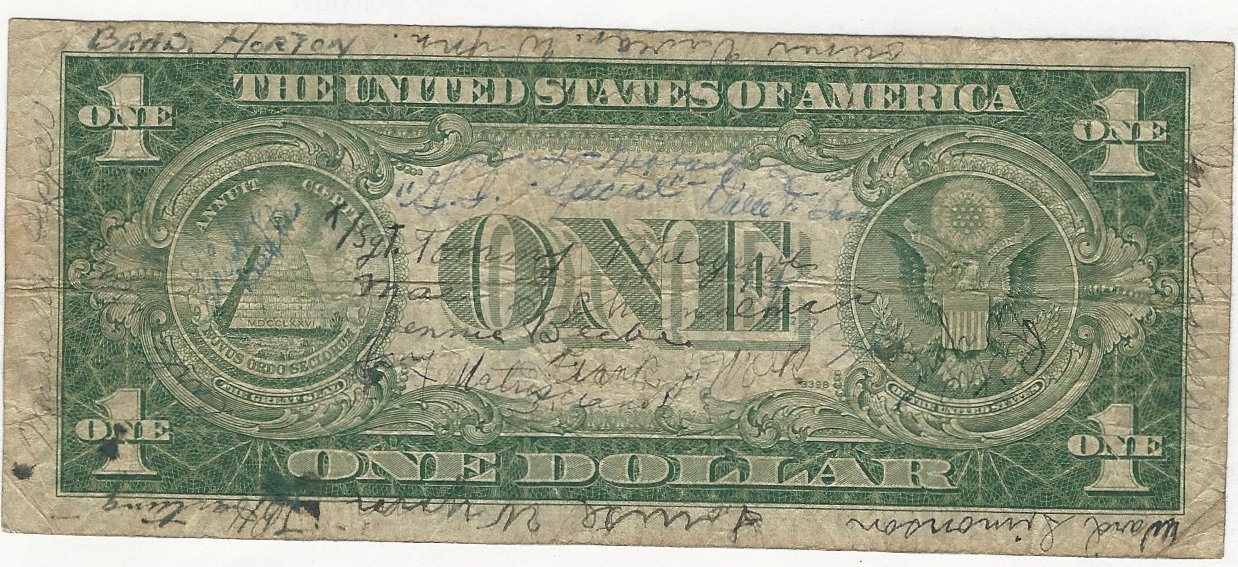
Short Snorters

A short snorter is paper money, signed by people who share a common experience. During World War II, with 16 million men and women in the American armed forces, the custom spread rapidly. After the war, it faded just as quickly.
(This is based on a prior publication for the Georgia Numismatic Association GNA Journal, Summer, 2002. The changes here resulted from further research and fact-checking.)


Although soldiers and sailors knew about short snorters, they first were popular with airmen because the tradition began in the 1920s among barnstormers. According to a September 26, 1984, story in Coin World, a pilot named Jack Ashcraft started it in August 1925 among the aviators of the Gates Flying Circus. The air show had a supply of stage money. Ashcraft signed his name on a play dollar. He then approached Clyde Pangborn. Ashcraft asked Pangborn if he had a dollar. He did. Ashcraft told him to sign his name on it. What for? You’ll see… Pangborn later flew into aviation history by crossing the Pacific with Hugh Herndon, Jr. Short snorters began a history of their own.
            A similar story is repeated in The Happy Bottom Riding Club: the Life and Times of Pancho Barnes by Lauren Kellen (Random House, 2000). Barnes was the granddaughter of Civil War balloonist Thaddeus S. C. Lowe. A barnstormer herself, and holder of a speed record, she played a male pilot in the Howard Hughes production Wings (1927). Her dude ranch and bar was a hangout for test pilots from Edwards Air Force Base. A “short snort” is a pour of whiskey. If you signed a bill with someone and later could not produce it when challenged, you had to buy the next round of drinks.  It is important to understand that this was during Prohibition, when alcohol was supposed to be illegal.


Any occasion could motivate the creation of short snorters. The crew of an airplane would swap notes the first time they crossed the equator, or landed on foreign soil.  During World War II, the practice spread from aviators to the soldiers, sailors, and marines they carried.  Wounded men going home would collect a signed paper dollar from each buddy: “When you get home, pal, have a snort on me.”
            During World War II, troops were paid in the currency of the country they were occupying. Fighting in Europe, Africa, and the Pacific, they could be paid in Dutch guilders, British pounds, or French francs, as well as American dollars. It was common for warriors, medics, and civilian contractors to build long streamers of short snorters in those and many other currencies. Having the longest roll was itself soon a challenge.
            It also mattered who autographed the money. The signatures of General Eisenhower, Eleanor Roosevelt, and Bob Hope are among the notables. The rolls became living diaries.
            You can find many stories online. Among them are the attributions of USAF LTC Edward Konyati, who not only had an impressive roll of his own, but also went on to collect and identify others, making it a lifelong hobby.  (See, for example, this August 20, 2000, story archived at the Orlando Sentinel.   Trans World Airlines (TWA) Captain Larry Girard authenticated a short snorter from the Air Transport Command of World War II.  His story from the June 9, 1980, issue of Skyliner magazine is archived here. 

But when the war ended, so did the tradition.

Previously on NecessaryFacts

Wednesday, September 14, 2016

Challenge Coins

According to numismatist Martin J. Price, monetary coinage was invented about 600 BCE as a form of bonus payments to Greek mercenaries.  “[As] bonus payments, the coins are more akin to gifts (or medals) than to coins as we know them.” (“Thoughts on the beginning of coinage,” in Studies in Numismatic Method Presented to Philip Grierson, Cambridge University Press, 1983).
Coin awarded by Texas State Guard Commanding General
Maj. Gen. Gerald "Jake" Betty
"Do your duty. Take care of your people. Go home with your honor."
(This is based on a prior publication for the Georgia Numismatic Association GNA Journal, Summer, 2002. The changes here resulted from further research and fact-checking.)

            Several series of denarius coins were struck specifically for Roman legions. The denarii issued by Marc Antony before his defeat at Actium are probably the most famous. Those coins show the legionary standards, and give their numeric designations. Other Roman coins also carry the counterstamps of specific legions. Why they were counter-marked is not clear to us today. But clear enough among the dozen or so issues are the coins of Legio X Fretensis, which was stationed in Judaea and Syria.
Coin awarded by the commander of Domestic Operations,
Texas Military Department,
Gen. Patrick M. Hamilton
            A challenge coin (also called a “unit coin”) is a medal or medalet, as large as a silver dollar or as small as a 25-cent quarter.  The coin carries the insignia and motto of a military unit. They are intended as awards for singular service, and are seldom granted to large bodies.  Each member of a squad or platoon may be given one for a team service. Being awarded to each member of a battalion is unheard of so far. In any case, the coin is awarded individually. The preferred method is for the coin to be enclosed in a handshake. It is not a public ceremony, but a private acknowledgment from a leader to those who have demonstrated exceptional service. The coin is a symbol of membership in a select group.
            Today, the enameled medalets are usually awarded by company commanders, or the “tops” of grades or occupations, such as sergeant majors or chief warrant officers.  They are called “challenge coins” because the soldier caught without theirs will have to buy the next round of drinks or perform some other ritual.  Researchers can point to several origins for them.
            Challenge coins were independently invented by US soldiers in Germany who had “pfennig checks” to see who was carrying the small coins of post-war West Germany. During Viet Nam, the check was for 1-dong aluminum coin of 1964. Thirty years later, soldiers were “coined” to see who had an Iraqi dinar.
Coin awarded by the Senior Enlisted Advisor
to the Commanding General TXSG
Sgt. Maj. Brian Becknel
            Writing for the NCOA Journal (Nov-Dec 2000) Vince Patton, Master Chief Petty Officer of the Coast Guard, placed the origin of the unit coin in the Second Boer War. According MCPOCG Patton, a regimental sergeant major would call his unit to muster in order to recognize the distinct bravery of one or more of the irregular volunteers who were not eligible for regular military awards.  The RSM would give “a firm, steady, and handsome handshake” to the soldier while palming to him a six pence.  The silver 6p of 1899 was about like a US dime of the same era: it was not intended as payment, but as a symbol.  They became the regimental coins for those who had served with valor.
            The history provided by Maj. Jeanne Fraser Brooks in the August 1994 issue of Soldiers (the official US DoD magazine) is the one most often found in citations such as Wikipedia.  If you put “challenge coin jeanne brooks” in your search engine you can find out-takes from her article on many Internet sites dedicated to challenge coins. Brooks found the roots of the unit medalet in the story of an American pilot during World War I.

“In one squadron a wealthy lieutenant ordered medallions struck in solid bronze carrying the squadron emblem for every member of his squadron. He himself carried his medallion in a small leather pouch around his neck.” Shot down by the Germans and captured, his papers were taken. He soon managed his escape. Without identification, caught anew by French farmers, he might have been shot as a German spy, but he still carried the squadron emblem. It saved his life. “Back at his squadron, it became a tradition to ensure that all members carried their medallion or coin at all times.”

            Maj. Brooks also told the story of LTG William Wilson “Buffalo Bill” Quinn. When he was a colonel during the Korean War, he created medallions for his regiment. The facts are relayed, somewhat differently, on the “Together We Served” website, a private service for US veterans. 

Promoted to Colonel, he would later serve as the G2 for the Army's X Corps, but in January 1951 he was given command of the 17th Infantry Regiment. It was his first command of combat troops. The 17th Infantry had just received a new call sign-"Buffalo," and COL Quinn decided to call his troops the Buffaloes. The regiment mailed home press releases about the Buffaloes and a short time later war correspondents began to call him "Buffalo Bill." The name stuck. Clay Blair in The Forgotten War wrote: "Almost overnight the Buffaloes became famous. Hundreds of GIs requested a transfer to the outfit; some even went AWOL to join." (Read LTG Quinn’s full biography here.) https://army.togetherweserved.com/army/servlet/tws.webapp.WebApp?cmd=ShadowBoxProfile&type=Person&ID=191748 )
Coin awarded by the Instructor Cadre
Officer Candidate School
of the Texas State Guard
"Ductus Exemplar"
            Other commanders later created their own medallions, among them the Green Berets. Slowly growing in awareness and familiarity over the decades, they blossomed in the post-9/11 military environment.  Unit coins spread from of the military to the allied communities of public safety and security responders.  Employees of the Department of Defense and the FBI are not alone in designing and purchasing team coins.  They are known to police departments and emergency medical transport firms. Coins have become so common that many people collect coins that they did not earn, trading duplicates with friends, and even buying them online. 


PREVIOUSLY ON NECESSARY FACTS