Showing posts with label philology. Show all posts

Tuesday, July 3, 2018

Forbidden Planet

Forbidden Planet influenced my passion for languages. I first saw it on television as a movie special when I was in my early teens. Professor Morbius was a philologist in a genre whose common characters are physicists, chemists, astronomers, and engineers, all in the plural. Morbius unlocked the language of the Krell, and doubled his intelligence with one of their machines. Psychology was the other underutilized science that drove the plot of Forbidden Planet to its conclusion. The “id” is called an archaic idea, long since abandoned, but the construct does explain the action, as surely as the other technobabble describes the ship’s hull, engines, navigation, and weaponry. As interesting as it is, I never had the drive for studying psychology that I have for words, their meanings, origins, and uses. 
 
Blade and blood share a root meaning.
Many of the "bl" words do.

When Mom bought the house a new dictionary, 
I spent hours reading etymologies. 

 My mother’s family was Hungarian. Although English was the official language of our home, Hungarian was impossible to avoid. My brother and I were encouraged to take foreign language classes in school as soon as they were offered. He started with French in the third grade. I had to wait until the seventh to begin German. At that same time, when telephoning my friend, John, I learned to get through to his mother in Ukrainian: "Mazhu ya hovoriti do Vanya?" And to listen for the reply, just in case, "Yo ho ne ma doma." (He is not at home.) Over the years of junior and senior high school, I spent hours just browsing the foreign language stacks in main branch of the Cleveland Public Library. It was a moment for me when I read the title Szep Uj Vilag and understood the meaning: Pretty [Brave] New World, itself another reference to The Tempest.
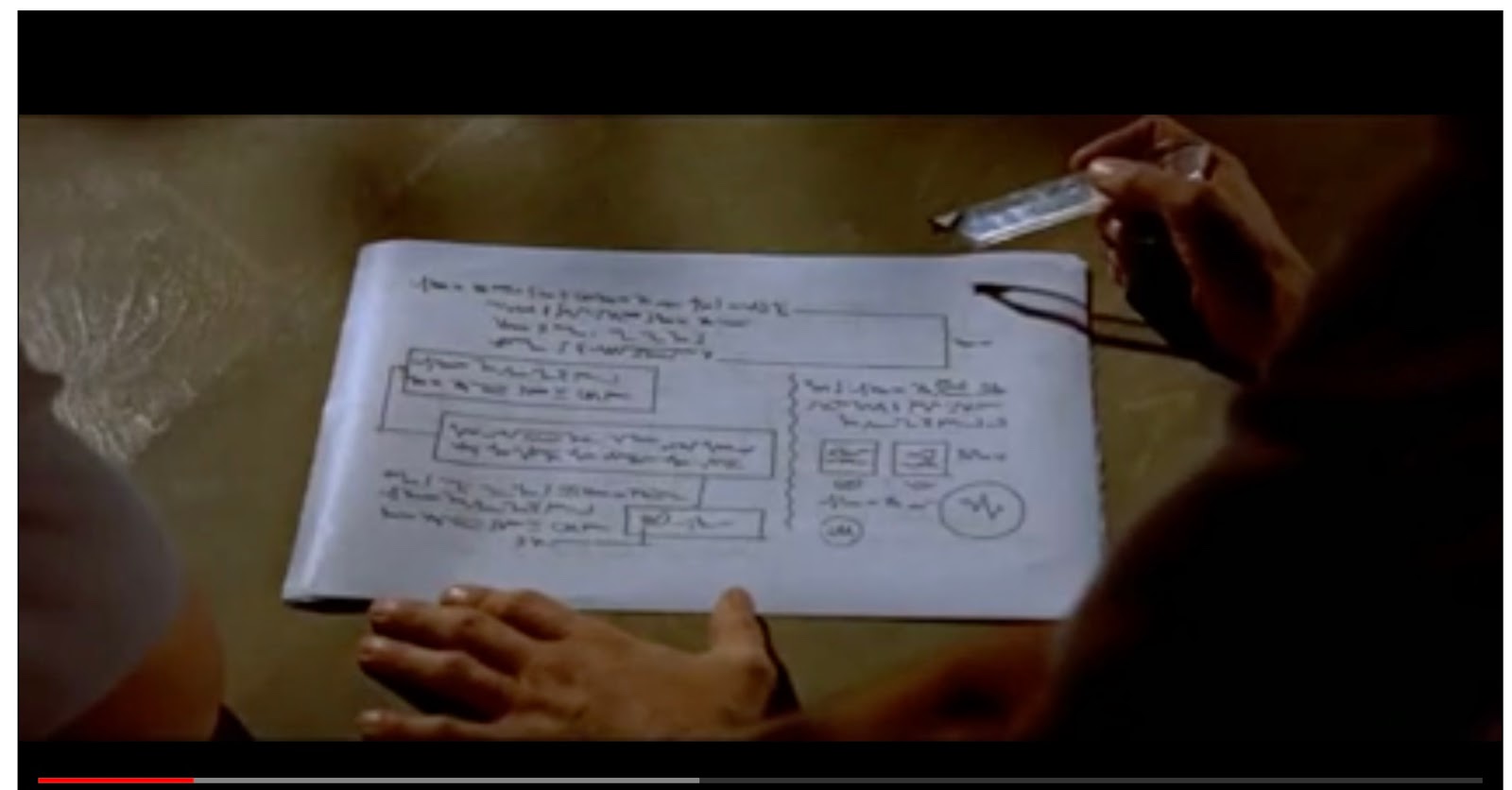
Decrypting the language of the Krell
At Lansing Community College in 1990, I had two classes in conversational Japanese for business before going to work for Kawasaki. The writing was not as much of a challenge for me because when I was about 12 I found a book at my neighborhood branch library on Chinese characters. In it, an American boy whose father is an engineer, learns from an Old Master how to write about 20 characters. Around that time, I began collecting Berlitz and other guides for tourists. 
The Monster of the Id
Fifteen years later, I was a campus safety patrol officer while majoring in criminal justice at Washtenaw Community College. Once a month, on Sunday night, one of our classrooms was used by a Persian Poetry Group. They were ethnic Iranians from Detroit and Grand Rapids who met to discuss world affairs. The building had to be cleared and locked by 11:00 PM. I began with “Welcome,” “Good evening,” and “How are you?” and after a few months, I was up to “It is getting late, is it not?” One of them asked me if I was Turkish. “No,” I replied. “Why do you ask?” “Because,” he said, “you speak Farsi with a Turkish accent.” Not bad.
Oh, brave new world
that has such creatures in it!
Here in Austin, I found myself waiting at the bus stop several mornings a week with neighbors who looked almost Oriental and spoke something that sounded almost Arabic. I inquired politely. They were Uzbeks. No problem: the Austin City Library has books for tourists on the languages of central Asia. 
The IQ Test
My first computer language was Fortran. I followed it with Basic. Lansing Community College had an IBM 5100 that was programmable in APL. The school library had books about computer languages; by 1976, there were over a hundred. Ten years later, I was setting type with TeX/LaTeX, the foundation of SGML. I met a computer literacy requirement for my bachelor’s with a class in Java. When I moved to Austin, I took a community class in Ruby.

As for the movie, it has held up well over time. With The Tempest for its model, the plot was tried and true. The writing and acting were competent. The special effects were innovative. In fact, live action shooting took only a couple of months and the artwork required another eighteen. The high-quality workmanship continues to deliver value.

PREVIOUSLY ON NECESSARY FACTS


Sunday, November 20, 2016

Spoken American Grammar

"If he was to go to the White House..."  
"A group of men were on their way..."

Languages change. We know that.  Years ago, working for yet another software development firm, I asked the engineers to write up management summaries of their parts of this project. One of them turned in work that was below high school level.  I went to his office and asked him about it.  "You write in a computer language," I said. "It has grammar, syntax, and vocabulary.  How can you not write well in your native language?"  He replied that in his mind, he was not writing sentences, but stringing connections on pulleys.  He built machines with computer code as his "Erector Set."  A few days later, he came into my office.  "Languages change," he said.  I agreed, of course.  "So, how does this happen?  Do academics and professors get together and write new rule books for us to follow?"  Of course not, I admitted. Languages change and somewhere along the way, it is noted and rules are amended. "So," he replied, pressing his point, "if you follow the manual, you are not using the current version."

Our local NPR affiliate (KUT-FM), also carries the BBC World News.  I heard a collective noun used as a plural: "The team were traveling to ..."  I perceived that as an older construction, not a modernism.

It is an interesting generalization that so-called "primitive" languages have more complicated grammars than the languages of civilized peoples.  In The Right Stuff, Tom Wolfe noted that Chuck Yeager sometimes fell into an archaic verb form of "helped" as "holped."  We have three tenses now with "help" as a weak verb: help, helped, has helped. In Anglo-Saxon and Old German, it was: help, halp, holpt, yholpen.  

When I was in the first grade, one of my classmates, newly arrived in Cleveland from West Virginia, always began sentences with consonants even when reading: "Hit is a dog. See the dog." Later, at the College of Charleston, my professor of German, a philologist, identified that as another archaism.  Some years later, working in Cleveland, a Slovenian colleague said that European Slovenians find American and Argentinian Slovenians speaking with rural forms no longer heard back home.

Another change, brought into common American by African-American urbanites is the strong past tense.  "I had gone to the store." for "I went to the store."  

I believe that the reflexive is also fading.  "I did it for me." rather than "I did it for myself." 

Maybe I just notice these because I heart languages.  I believe that the fundamental purpose of language is to enable thinking.  Communication with others is a secondary consequence.  It is true that human language evolved from animal calls. However, that is in our past, and for about 5000 years, self-awareness has been the primary function of modern language.

ALSO ON NECESSARY FACTS

Tuesday, July 28, 2015

Linguistics Debate: What Colors are Your Rainbow?

We too easily assume that our Paleolithic ancestors perceived the natural world of trees and sky the same way that we do. However, sensation is not perception. They may well have had the same physiological sensations, but their perceptions were necessarily different because language tells a person what they perceive. Between sensation and perception, the percept is an integration of two or more sensations. That integration is automatic. Percepts are self-evident. They are the basis of knowledge. However, concept-formation is volitional; it is not automatic. (See Introduction Objectivist Epistemology by Ayn Rand.)

“In Japan, people often refer to traffic lights as being blue in color. And this is a bit odd, because the traffic signal indicating ‘go’ in Japan is just as green as it is anywhere else in the world. So why is the color getting lost in translation? This visual conundrum has its roots in the history of language.

Blue and green are similar in hue. They sit next to each other in a rainbow, which means that, to our eyes, light can blend smoothly from blue to green or vice-versa, without going past any other color in between. Before the modern period, Japanese had just one word, Ao, for both blue and green. The wall that divides these colors hadn’t been erected as yet. As the language evolved, in the Heian period around the year 1000, something interesting happened. A new word popped into being – midori – and it described a sort of greenish end of blue. Midori was a shade of ao, it wasn’t really a new color in its own right.” (From The crayola-fication of the world: How we gave colors names, and it messed with our brains (part I) here.) 
“The color debate was made popular in large part due to Brent Berlin and Paul Kay’s famous 1969 study and their subsequent publishing of Basic Color Terms: Their Universality and Evolution by Brent Berlin and Paul Kay, Berkeley: University of California Press: 1969. Berlin and Kay also found that, in languages with fewer than the maximum eleven color categories, the colors followed a specific evolutionary pattern. This pattern is as follows:

  • All languages contain terms for black and white.
  • If a language contains three terms, then it contains a term for red.
  • If a language contains four terms, then it contains a term for either green or yellow (but not both).
  • If a language contains five terms, then it contains terms for both green and yellow.
  • If a language contains six terms, then it contains a term for blue.
  • If a language contains seven terms, then it contains a term for brown.
  • If a language contains eight or more terms, then it contains terms for purple, pink, orange, and/or gray.”
(See "Linguistic relativity and the color naming debate" in Wikipedia here.)
Those "rules" are debated.  One problem that Berlin and Kay faced was borrowing. People learn new ideas from their neighbors. To take a case in point, consider Hungarian.  Magyar has three native terms for color, but none of them is "red."
Red
piros
borrowed from “rosa”
Orange
narancs
borrowed from “aurum”
Yellow
sárga
native (sar is “mud, mire, dirt’ sarj is “shoot, sprout, or bud”)
Green
zöld
native
Blue
kék
native
Violet
lila
borrowed
Brown
barna
Borrowed
bor is wine; sör is beer


The problem of black and white speaks to growth in vocabularies by differentiation: hyper, hypo; super, sub; friend, fiend; divine, devil. Black and white in Hungarian are fekete and fehér. They are at root the same word, but changed slightly for meaning. We still have vestiges of that specifically with blank (Spanish blanco=white) and black.

ALSO ON NECESSARY FACTS


Friday, July 10, 2015

Language and Thought: As You Think, So You Speak

The primary purpose of language is thought. Communication is secondary. It is true that language evolved out of animal calls. Ravens have 30 calls in three dialects. Our grunts, coos, and growls are necessarily more complex. The origins of modern language are unclear and the purpose of language is largely misunderstood.

One way to think about this is by analogy to geometry. Practical geometry goes back 3000 years, perhaps. We know of clay tablets with cuneiform tables of Pythagorean triples.  But formal geometry began only about 300 BCE.  So, too, did language originate with animal calls, but now serves a more abstract and sophisticated purpose.

We largely trace our modern speech back to about 10,000 years to 8000 BCE. Nostritic is a  construct that unites all Afro-Asian languages, but is highly putative. Nonetheless, it is suggestive. Proto-Indo-European is on firmer grounds but is only 6000 years old.

In the 18th century, European intellectuals stumbled on the fact that the languages of India share deep roots with the languages of Europe. Words such as mother, father, and brother, the first ten numbers, and other basic vocabulary suggested a common origin. Words for “beech” and other clues indicated the ancestral home of the “Caucasians.”
These languages all evolved from a common ancestral tongue called Proto-Indo-European (PIE), spoken ca. 6,000 years ago by a people living (by "traditional" hypothesis) somewhere in the general vicinity of the Pontic Steppe north of the Black Sea and east to the Caspian -- an area that, perhaps not accidentally, seems to coincide with the land of the ancient Scythians, from the Ukraine across far southwestern Russia to western Kazakhstan – “Indo-European Languages Evolution and Locale Maps,” by Jonathan Slocum here. 
 It is easy to see that modern languages from Greek and Latin to German and English grew by differentiation.  We know the prefixes hyper and hypo, sub and super. They indicate some motion or distance away from you, or by extension some other reference, above or below.  Beer and wine were originally the same thing: fermented liquids, but we differentiated them, by their origins, grain or fruit.
http://www.ling.cam.ac.uk/li7/grimpie.gif

At the same time, long statements commonly understood were compressed by slang.  The word “nest” is a contraction for “nether sitten” because a nest sits down upon the branches. Today, we ask, "Wussup?"

Philologists could not ignore baby talk: we imitate our children, from “moo" for cow to “choo-choo" for train.

We all play with words. British slang calls a girl a “bird” but that is a transposition from “bride” just as the “butterfly” was originally the “flutter by.” 

No woman likes being called a whore. The rules of philology show that “whore” is the Germanic (die Hure) form of the Romance “cara” (dear).  In Italian, you can say “Cara mia” and get a kiss, but “meine Hure” does not work so well in German.  They are the same word at root.  The K in Latin becomes an H in German.  (centum = hundred; cortus = heart) That led some philologists to look for mountain ranges on the theory that those ancient ancestors aspirated their Ks while climbing uphill. The assertion did not stand up, but it does point to the kinds of ways that languages do change.

In our time, it is ROTFL and LOL, and the full range of emoticons from the simple smiley face to the inventory on your smart phone. 

The bottom line is that how you speak (or write) derives from how you think; and, conversely, how you think manifests itself in your speech (or writing). The two are different. I am often embarrassed, if not horrified, by my own vernacular speech. I take more care with my writing. OTOH YMMV.

The fact remains: what is in your head determines who and what you are. Language is the medium and means and mechanism of thought. Alone on an island, you would have no one to speak to, but the words in your head would predict your chances for survival, even as you imagine felled trees becoming a raft.


ALSO ON NECESSARY FACTS

Friday, May 17, 2013

Sándor Kőrösi Csoma


He walked from Hungary to Tibet and brought the language of Tibet to the West.  His grammar of their language is also the foundation of our knowledge of their religion because he worked from the holy books of Lhasa monks.  His name is variously rendered: Alexander Csomo de Körös is also accepted.  He called himself a “Siculo-Magyar” and I thought that (like me) he was Sicilian and Hungarian, but, in fact, “Siculo” is a latization of Szekel, the hereditary guardians of the Hungarian frontier who claim direct descent from the remnants of the Huns. 
Portrait drawing in ink facing right of man about 45 or 50 years of age, thin, but strong
Portrait by August Schoefft
from surreptitious sketches

For over a hundred years, the life story of this obscure scholar was presented in a single biography by Theodore Duka, M.D., first written in 1885 and then reprinted in a limited edition of 1000 by Manjursi Publishing House of New Dehli in 1972.  Then in 2001, Short Books of Croyden, Surrey, came out with a new work by Edward Fox, much shorter, but obviously benefiting from resources liberated by the fall of communism.  Fox’s story illuminated details of Kőrösi Csoma’s depth of character. He was consistent, principled, and self-generating. He hoarded the cash coins in gold and silver which others invested with him for his travels and research, while he lived on figs and less.  Trekking with caravans, he had passed himself off successfully as “Sikander Beg” a Persian. 

Sandor Kőrösi Csoma believed that the homeland of the Hungarians was in the Himalaya Mountains.  The theory was widely asserted in his day.  The point is still in dispute.  By our best knowledge today, the Magyars are Finno-Ugritic people, cousins to the Samoyed, Ostyak, Vogul, and Finns of northwest Asia but “influenced” linguistically if not genetically, by Turkic peoples of central Asia.  The Hungarian word for “dog” is “kutya” and would be understood directly by the Ostyaks and Voguls.  The Hungarian word for “three” is “három” which obeys rules supporting the Finnish near-cognate “kolme.”  But in Hungarian, the vowels in a word all have the same pitch, as in Turkish.  For example, a noun becomes an adjective by adding “sag.”  The word for politically or legally free is “szabad”; and “liberty” is szabadsag.  But a nice word for your brother is “tesztver” and “fraternity” is “tesztvereseg”.  The deeper “a” becomes the higher “e” to maintain the consistency of sound within the word.

Two sides of the coin.Heads facing left is the portrait by Schoefft. Tales side has Tibetan
100-forint commemorative coin
celebrating the 200th anniversary
of the birth of Sandor Kőrösi Csoma.
But all that came after the lifetime of Sandor Kőrösi Csoma: 1784 to 1842.  In his time, Hungary was suffering under the Austrian crown for their revolts, especially that of Ferenc II Rákóczi from 1703 to 1711.  However, that struggle brought sympathy and support from England, evidenced by a trust of ₤11,000 raised and held by the Archbishop of Canterbury. Hungary always had a strong Protestant minority. Csoma’s primary and secondary education was at a Calvinist school where he eventually became a lecturer in poetry. So, Csoma found ready support from British consuls and merchants as he walked from Egypt to Persia, Afghanistan, and India.
Cluster of whitewashed dwellings all connected on the ledge of a mountain
Monastary at Zanskar
(Wikimedia Commons)

He was 35 years old when he left Bucharest on November 1, 1819.  He had studied and mastered languages all his life, including formal enrollment at the University of Göttingen to attend lectures in philology.  His letters to Captain C. P. Kennedy, assistant political agent at Subathú, summarizing his journey and explaining his intentions, were in English.

Csoma spent eighteen months with the abbot of Zangla in the Zanskar region of what is today the Indian state of Jammu and Kashmir in the Himalayas.  He compiled a 40,000-word dictionary and a grammar of Tibetan.  These he left with the Royal Asiatic Society at Calcutta before traveling back into the mountains where he died of a fever at Darjeeling.