Showing posts with label paradigm shift. Show all posts

Sunday, February 7, 2021

BINARY STAR PROJECT

Finding binary stars has been fun and rewarding on several levels. First is the satisfaction from perceiving something that is not obvious to animal sensations. A modest telescope reveals that very many stars which appear as one are actually pairs and systems. Finding them required getting more familiar with the night sky and learning is fun. And there was discovery: even though someone else had found it first, the insight and understanding were my own. 


Binaries and systems are the rule, not the exception. The stars are not randomly scattered individuals—though those do exist, even wandering rogues—but aggregations that are bound by internal and external gravity, and other forces and fields. 


Epsilon Lyrae is a famous double-double.
I was encouraged to pursue it by friends online
at TheSkySearchers dot com.

In the 200 years after Galileo, telescopes opened the heavens to exploration. Wanting to measure the distances to the stars, astronomers sought certain pairs, a very bright one and a much dimmer one. The assumption was that stars are randomly distributed. So, if two neighboring lights were different in apparent magnitude, the brighter one was much nearer, and therefore measurable with the instruments of the time. It was the search for parallax. After cataloguing thousands of stars and hundreds of binaries with one of the largest telescopes, while parallax measurements remained beyond our grasp, William Herschel came to understand that binaries are a natural phenomenon, not visual accidents. 


Polaris (left) and Alcor-Mizar (right)
in Meade 10-inch catadioptric on loan from 
the Austin Astronomical Society.

Following William Thompson’s mandate,  I want to measure what I observe. In another topic I mentioned having been loaned a Baader Micro-Guide reticle. But even before that, I figured out that I could keep both eyes open and use a simple ruler to help me scale my sketches. I can calculate the field-of-view, and with a compass and graph paper, set a circle into which I can draw my observations.


One night, while aligning on Mars,  I happened upon the binary Eta Piscium. At that point, I had followed instructions to locate five or six such objects, including the “Double-Double” in Lyra. When I saw them, they just looked like a binary. So, I noted the time and approximate location and looked them up later. 


My last investigation (03 February) was Castor in Gemini, an easy double, and revealed in the largest telescopes to be a system of six.


I learned of Zuben Elgenubi from a Hayden Planetarium
show in July 1969. Looking it up online, I found that it is
an easy double and a complex system.

All of that let me retrace the steps of the first pioneers in astronomy. On the one hand, I know from my own university education and from judging regional science fairs for over a decade, that we do not reward scientists for repeating and testing the works of others. We prize originality so much that perhaps one-half to three-fourths of all published papers are never independently validated, all the moreso in physics (and astronomy), less so in chemistry and sociology which are practical pursuits. So, I like knowing that the universe is pretty much as described. On the other hand, revisiting the discoveries in astronomy is analogous to the small wonder of holding an ancient coin and understanding it as a window into the cultural context of their time and place. 


PREVIOUSLY ON NECESSARY FACTS


Measuring Your Universe: Alan Hirshfeld’s Activity Manual

Base 7 

Turing’s Cathedral 

Numismatics: History as Market 


Thursday, December 20, 2018

Eclipses?

Obvious though it seems, how and why solar eclipses became important to our civilization is not at all clear. The path of totality is narrow and fleeting, gone in about six or seven minutes. I never experienced a total eclipse, but I have seen three partials: September 20, 1960, May 10, 1994, and August 21, 2017. In every case, had it not been announced long in advance, I would not have known from common experience just what—if anything—had happened.

It is often repeated, citing Herodotus, that Thales of Miletus predicted the solar eclipse of May 28, 585 BCE. How he did that is not recorded. We take for granted our Arabic numerals and positional notation. Absent them, calculation is even more painfully laborious than most of us experience it to be. And the Greeks used geometry, not arithmetic. 
 
Just one construction from
"On the Sizes and Distances of the Sun and Moon" by
Aristarchus of Samos from Aristarchus of Samos:
The Ancient Copernicus
by Sir Thomas Heath
(Oxford University Press; 1977, 1913).
Having long kept records, the Babylonians were aware of the 18-year cycle of eclipses. (18 years 11 days plus a third of a day. See the explanation of the Saros Cycle at Wikipedia.  )

The Chinese also kept records of eclipses, at least back as far as 1302 BCE, the first perhaps in 2159 BCE. (“The eclipse in China”, F. Crawford Brown, Popular Astronomy, Vol. 39, p.567 at The Digital Library for Physics and Astronomy at Harvard  and “Examination of early Chinese records of solar eclipses,” Liu, C., Liu, X., & Ma, L., Journal of Astronomical History and Heritage (ISSN 1440-2807), Vol. 6, No. 1, p. 53 - 63 (2003) at the same archive. )

That being as it may, explanations for the physical events—that the Moon and Earth cast shadows on each other—were lacking until the Greeks, again, beginning perhaps as early as 600 BCE, but certainly known to Aristotle c. 300 BCE. Nonetheless, that knowledge was not widespread.
“The majority of people didn’t really understand what eclipses or shooting stars were until at least the 17th Century,” says Edwin Krupp, director of the Griffith Observatory in California. The ancient Greeks weren’t alone, either.
While a handful of astronomical scholars, from the 8th Century BC onwards, successfully understood the celestial mechanisms behind an eclipse, for another 2,000 years most of the world’s population clung steadfastly to the ancient belief that astronomical events, and particularly solar and lunar eclipses, were the work of the gods. (BBC here.)

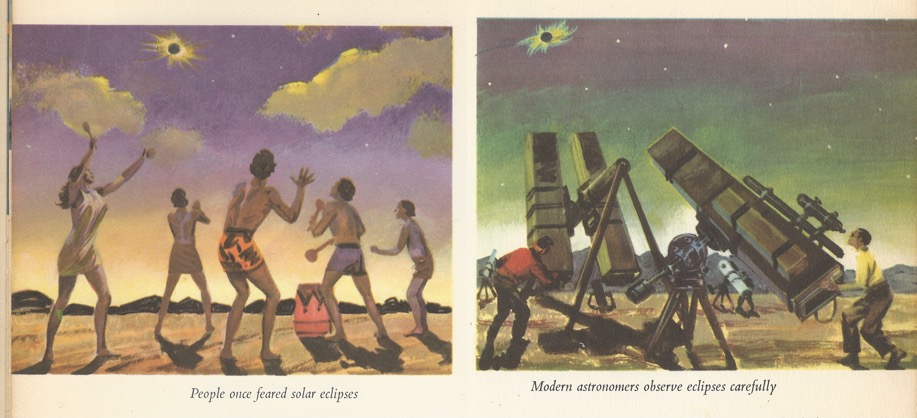
Primitives and Moderns both react to solar eclipses.
(Left: "People once feared solar eclipses" 

Right: "Modern astronomers observe eclipses carefully")
The Golden Book of Astronomy: A Child's Introduction to the Wonders of Space
(Simon & Schuster, 1958, 1955).
My best eclipse was May 10, 1994. The sky did grow visibly darker. The air turned cool. The birds were silenced. But it was impossible to look directly at the sun. For that, I built a viewing box to project the image on a sheet of paper. The first partial eclipse I witnessed on September 20, 1960, was an annular, a ring, because the Moon was too close to the Earth to completely block the Sun. What I saw was a partial annular, a geometric “lune” the shape of part of one circle over another. Although I had exposed film to view it through, the cloud cover was just right to view the sun directly. The third time, although some clouds passed by they were not dense enough to allow direct observation of the Sun. If I had not had exposed film to view through, I would not have known that the eclipse occurred at all: no other environmental changes were manifested.

Lunar eclipses are impossible to ignore. The Earth's shadow is large. The Moon often rises red, blue light being absorbed by our atmosphere. The Moon darkens almost to full black. The entire event takes hours.  

Every Lunar eclipse is followed by a Solar eclipse. However, as noted above, the path of totality is narrow and the duration of darkness is just minutes. You would have to be a pretty good sprinter to cover the mile from your field to your home to the village to the church in time to pray before it would all be over. And people 200 miles away might not be aware that anything happened at all. 

PREVIOUSLY ON NECESSARY FACTS

Wednesday, December 19, 2018

What are the Stars?

The stars were conceptually intractable. What they were was never understood until modern times, but by 600 BCE when Odyssey was written down, constellations had names. “Glorious Odysseus, happy with the wind, spread sails and taking his seat artfully with the steering oar he held her on her course nor did sleep ever descend on his eyelids as he kept his eye on the Pleiades and late-setting Boötes and the Bear, to whom men give also the name of the Wagon, who turns about in a fixed place and looks at Orion and she [the Bear] alone is never plunged in the wash of the Ocean. For so Kalypso, bright among goddesses, had told him to make his way over the sea, keeping the Bear on his left hand.” The Odyssey, from the translation by Richmond Lattimore, Perennial Classics HarperCollins 1999. Cited at http://ircamera.as.arizona.edu/Astr2016/lectures/ancientast.htm
 
80 Pfennig Stamp (canceled)
Fraunhofer Bicentennial 1987
Federal Republic of Germany
Anaxagoras, Democritus, and other ancient philosophers suggested that the stars are Suns very far away. However, close as it sounds to the accepted facts, they lacked any scientific evidence for that claim. Perhaps the most cogent insight was from the Native Americans who called them the campfires of the council of chiefs. At least, that was based on experience. Apparently, some savants of medieval Europe suggested that the stars are holes in the sphere that separates us from  heaven. For that, no experiential evidence exists.

Giordano Bruno was burned at the stake in 1600 in part for claiming a multiplicity of worlds but in the next generation the fact that the Sun is another star and the stars are suns very far away was accepted, albeit without proof. Christiaan Huygens approximated the distance to Sirius by assuming that it is as bright as the Sun. His assumption was false, but his method underscores the fact that the nature of the stars was becoming accepted.

The problem was that the best telescopes that revealed stunning details of the Moon, Jupiter, and Saturn told us nothing new about stars. Anaxagoras said that the Milky Way is composed of very many stars, a fact that can be observed. That much the telescope could show in clear detail. But Sirius is just Sirius. 

It was not until 1814 that Joseph Fraunhofer invented the spectroscope. By 1817 he had completed many experiments with various sources, including sunlight. He died young, but forty years later, Gustav Kirchhoff and Robert Bunsen continued the project he began. They applied spectroscopy to the sun. Following them, William Huggins (1824-1910), Angelo Secchi (1818-1878) and Edward Charles Pickering (1846-1919) were among those who measured and catalogued the spectra of stars. We finally had empirical evidence that unified our particular star with all the other suns. 


PREVIOUSLY ON NECESSARY FACTS

Before Email

Patterns in Pi 

Bringing Philosophy to Athens: Aspasia of Miletus 

Awesome Austin Foods at the Wheatsville Co-op 


Saturday, January 6, 2018

The Philosophical Breakfast Club

If one person can change the world, four might do 16 times as much. The Philosophical Breakfast Club: Four Remarkable Friends Who Transformed Science and Changed the World by Laura J. Snyder (Broadway, 2011) is the story of Charles Babbage, William Herschel, William Whewell, and Richard Jones. They met at Cambridge about 1810. By 1860, through their hard work and consistent focus, modern science acquired the inductive method and public involvement (and government funding), that resulted in science evolving from a hobby to a profession.
picture shows bookshelf and open curtains with photographs of four yound men in 19th century dress

Snyder writes well. The book is engaging, compelling, sometimes challenging. We accept that science proceeds by paradigm shifts, but the advent of modern science was itself a radical redefinition. At the start of the 19th century, what we call “science” was “natural philosophy” and its practitioners were philosophers. It was at the first meeting of the British Association of the Advancement of Science on June 24, 1833, that William Whewell answered a challenge from Samuel Taylor Coleridge, and spontaneously offered the word “scientist.”

More to the point, natural philosophy was pursued by people of leisure, most often men, of course, but also the exceptional woman. No university offered a doctorate in science – only the doctor of philosophy. Though they demanded knowledge of mathematics, baccalaureate examinations did not test for science. By 1860, that changed. These four men made that happen. This is their story.

They all endorsed the inductive method of Francis Bacon. This was not the so-called "strong induction" of Karl Popper and the problem of the black swan which holds that final truth is always elusive because some new discovery will invalidate all we know. Rather, they wrote books and articles about an objective scientific method that begins with observations. Observations become inductive generalities. Those broad descriptions must be fit to a natural law, a deductive truth. However, knowledge does not proceed from pure deduction independent of experience.

Charles Babbage launched the first assault, making his work a personal crusade against the establishment. Reflections on the Decline of Science in England (1830) severely criticized the Royal Society in general and its leaders in particular for creating a social environment inhospitable to professional science, Richard Jones began by addressing economics with An Essay on the Distribution of Wealth, and on the Source of Taxes (1831). It was necessary to begin there because economics in particular was mired in error through rationistic, deductive theories from Thomas Malthus and David Ricardo. Jones demonstrated with statistics - also a new development - that life was getting better, not worse, even for the poorest. Whewell wrote History of the Inductive Sciences (1837) and Philosophy of the Inductive Sciences (1840). Herschel's Preliminary Discourse on the Study of Natural Philosophy (1840) was the introductory volume of Dionysius Lardner's Cabinet Cyclopoedia. His 1859 work, Physical Geography, was part of the Encyclopedia Britannica.


Charles Babbage, William Whewell, William Herschel, and Richard Jones fell out with each other after 50 years largely over religious interpretation. Everyone accepted that species come and go. The fossils that were revealed first by coal mining then by canal building established that. Does God create each new species? Babbage the computer maker said that God made a programmable universe that changes its actions according to a scheme invented once and left to run: "the divine clockmaker" of the Enlightenment. They had a hard time giving up the idea of God. Darwin - a frequent guest of Babbage's - eventually did. 

Only because The Philosophical Breakfast Club is praiseworthy do a couple of egregious errors stand out. Discussing the grief of William Whewell at the passing of his wife, Cordelia, Snyder identifies the elegiac as “a classical form of funereal verse famously employed by Ovid in the seventh century BCE.” (page 311) The elegiac may have its roots in archaic Greek culture, but Ovid (Publius Ovidius Nasso) lived some 600 years later. An editor should have caught that. An editor was probably responsible for the horrendous typographical error giving Maxwell's prediction for the speed of the electromagnetic wave as 310,740,000 miles per second rather than meters per second. (page 364)

Less tractable as an oversight, Snyder accepts our capitalist society (and its abundance), but she does not tie capitalism to the rise of science. Taken at face value, these four savants could have brought science to almost any century, surely any period after the Renaissance. Snyder does point out that people limited the size of their families in order to be able to afford the many new consumer goods, the inexpensive luxuries of mass production. But any medieval fair offered such vanities. Snyder also does identify the fundamental errors in the dire predictions of Malthus and Ricardo. What she misses is that public lectures and demonstrations became commercial ventures (as did symphony concerts). It was no longer necessary to be wealthy (or to have a wealthy patron). Unlike “natural philosophy” science was delivered as a service to consumers by competing providers seeking mass markets. Among those consumers were women. Formally disallowed at the Royal Society, they were welcomed at the British Association for the Advancement of Science. 


Also, Snyder accepts as given the benefits of government funding of science. Certainly, despite its costs and lack of completion, Babbage's Difference Engine would have been a great benefit, had it been constructed. His Analytical Engine would have compounded the return on investment from the public coffers. That said, of course, a consistent advocate of capitalism would have underscored the many private fundings of pure research through "public subscription" -- today called "crowd sourcing." But that was not the book that Snyder wrote. Taken on its own merits, The Philosophical Breakfast Club remains an inspiring story. 

Finally, considering its importance to the story, it would have been nice if Snyder had explained better the theory behind Babbage’s Difference Engine. Again, I understand the problem of mass marketing books about science. Even Stephen Hawking was prevented from using equations. This is what Snyder wrote (page 84):
“The method of finite differences relies on a peculiar fact about polynomial functions. Polynomial functions are algebraic expressions constructed from variables and constants using addition, subtraction, with non-negative, whole number exponents for example F(x) = x2 – 5x + 3. It is mathematical law that any polynomial function of order n will have its nth order difference constant, and each successive new value of the function can be obtained by n simple additions. So, for instance, a polynomial whose highest order is x2 will have its second order of difference constant, and require two additions to reach each successive value.  
“To build a machine that can reliably calculate squares, or any more complex polynomial function, Babbage, realized, he needed only create a machine that could add orders of difference based on initial values of a function and initial values of the orders of difference based on initial values from the start.”

True though that is, it is not illuminating to the reader who does not remember calculus. I would have said:
“Sir Isaac Newton’s calculus showed how to compute rates of change. An object falls to Earth (or the Moon orbits the Earth) with an acceleration proportional to the square of the time in motion. By the same laws, the attraction of gravity diminishes by the square of the distance. It is easy (now 300 years later) to show that the second difference of those squares—what we learned in calculus to call "the second derivative"—is constant. 
 “Therefore, it is possible to construct a machine whose wheels and gears, ratchets, and pawls, crank through these differences to get back to the original function. Because the functions of trigonometry can be expressed as summations of such square-power equations, a machine can calculate any common table needed for navigation – and can do so repeatedly and reliably.”
But I did not write the book. She did. And she did masterful work integrating the biographies of these four savants and putting their lives into context. 

Snyder proves her point first by telling of Darwin, who spent many hours in the company of Babbage. She reinforces the lesson with an introduction to the work of James Clerk Maxwell whose equations about electro-magnetism opened the door to the theory of relativity, which Einstein called “the electrodynamics of moving bodies.”

Many other pleasant suprises are here as well, such as Babbage's attack on the Vigenere Cipher. And if you want to raise a toast to science, you can do it with Booth's gin.

PREVIOUSLY ON NECESSARY FACTS