Friday, September 30, 2016

Short Snorters

A short snorter is paper money, signed by people who share a common experience. During World War II, with 16 million men and women in the American armed forces, the custom spread rapidly. After the war, it faded just as quickly.
(This is based on a prior publication for the Georgia Numismatic Association GNA Journal, Summer, 2002. The changes here resulted from further research and fact-checking.)


Although soldiers and sailors knew about short snorters, they first were popular with airmen because the tradition began in the 1920s among barnstormers. According to a September 26, 1984, story in Coin World, a pilot named Jack Ashcraft started it in August 1925 among the aviators of the Gates Flying Circus. The air show had a supply of stage money. Ashcraft signed his name on a play dollar. He then approached Clyde Pangborn. Ashcraft asked Pangborn if he had a dollar. He did. Ashcraft told him to sign his name on it. What for? You’ll see… Pangborn later flew into aviation history by crossing the Pacific with Hugh Herndon, Jr. Short snorters began a history of their own.
            A similar story is repeated in The Happy Bottom Riding Club: the Life and Times of Pancho Barnes by Lauren Kellen (Random House, 2000). Barnes was the granddaughter of Civil War balloonist Thaddeus S. C. Lowe. A barnstormer herself, and holder of a speed record, she played a male pilot in the Howard Hughes production Wings (1927). Her dude ranch and bar was a hangout for test pilots from Edwards Air Force Base. A “short snort” is a pour of whiskey. If you signed a bill with someone and later could not produce it when challenged, you had to buy the next round of drinks.  It is important to understand that this was during Prohibition, when alcohol was supposed to be illegal.
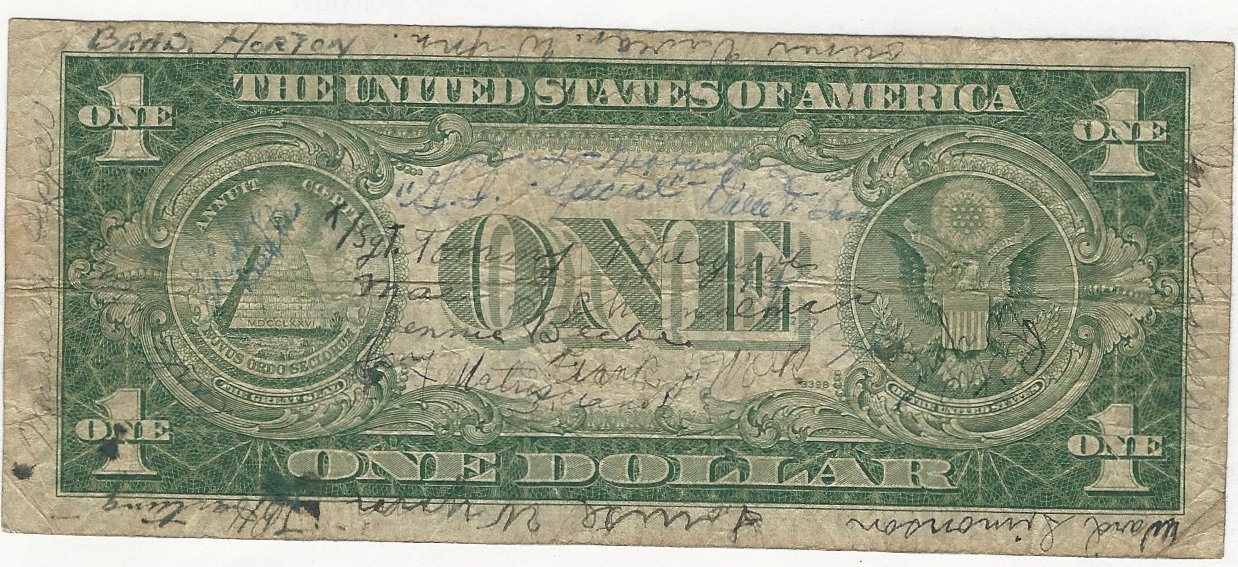


Any occasion could motivate the creation of short snorters. The crew of an airplane would swap notes the first time they crossed the equator, or landed on foreign soil.  During World War II, the practice spread from aviators to the soldiers, sailors, and marines they carried.  Wounded men going home would collect a signed paper dollar from each buddy: “When you get home, pal, have a snort on me.”
            During World War II, troops were paid in the currency of the country they were occupying. Fighting in Europe, Africa, and the Pacific, they could be paid in Dutch guilders, British pounds, or French francs, as well as American dollars. It was common for warriors, medics, and civilian contractors to build long streamers of short snorters in those and many other currencies. Having the longest roll was itself soon a challenge.
            It also mattered who autographed the money. The signatures of General Eisenhower, Eleanor Roosevelt, and Bob Hope are among the notables. The rolls became living diaries.
            You can find many stories online. Among them are the attributions of USAF LTC Edward Konyati, who not only had an impressive roll of his own, but also went on to collect and identify others, making it a lifelong hobby.  (See, for example, this August 20, 2000, story archived at the Orlando Sentinel.   Trans World Airlines (TWA) Captain Larry Girard authenticated a short snorter from the Air Transport Command of World War II.  His story from the June 9, 1980, issue of Skyliner magazine is archived here. 

But when the war ended, so did the tradition.

Previously on NecessaryFacts

Wednesday, September 14, 2016

Challenge Coins

According to numismatist Martin J. Price, monetary coinage was invented about 600 BCE as a form of bonus payments to Greek mercenaries.  “[As] bonus payments, the coins are more akin to gifts (or medals) than to coins as we know them.” (“Thoughts on the beginning of coinage,” in Studies in Numismatic Method Presented to Philip Grierson, Cambridge University Press, 1983).
Coin awarded by Texas State Guard Commanding General
Maj. Gen. Gerald "Jake" Betty
"Do your duty. Take care of your people. Go home with your honor."
(This is based on a prior publication for the Georgia Numismatic Association GNA Journal, Summer, 2002. The changes here resulted from further research and fact-checking.)

            Several series of denarius coins were struck specifically for Roman legions. The denarii issued by Marc Antony before his defeat at Actium are probably the most famous. Those coins show the legionary standards, and give their numeric designations. Other Roman coins also carry the counterstamps of specific legions. Why they were counter-marked is not clear to us today. But clear enough among the dozen or so issues are the coins of Legio X Fretensis, which was stationed in Judaea and Syria.
Coin awarded by the commander of Domestic Operations,
Texas Military Department,
Gen. Patrick M. Hamilton
            A challenge coin (also called a “unit coin”) is a medal or medalet, as large as a silver dollar or as small as a 25-cent quarter.  The coin carries the insignia and motto of a military unit. They are intended as awards for singular service, and are seldom granted to large bodies.  Each member of a squad or platoon may be given one for a team service. Being awarded to each member of a battalion is unheard of so far. In any case, the coin is awarded individually. The preferred method is for the coin to be enclosed in a handshake. It is not a public ceremony, but a private acknowledgment from a leader to those who have demonstrated exceptional service. The coin is a symbol of membership in a select group.
            Today, the enameled medalets are usually awarded by company commanders, or the “tops” of grades or occupations, such as sergeant majors or chief warrant officers.  They are called “challenge coins” because the soldier caught without theirs will have to buy the next round of drinks or perform some other ritual.  Researchers can point to several origins for them.
            Challenge coins were independently invented by US soldiers in Germany who had “pfennig checks” to see who was carrying the small coins of post-war West Germany. During Viet Nam, the check was for 1-dong aluminum coin of 1964. Thirty years later, soldiers were “coined” to see who had an Iraqi dinar.
Coin awarded by the Senior Enlisted Advisor
to the Commanding General TXSG
Sgt. Maj. Brian Becknel
            Writing for the NCOA Journal (Nov-Dec 2000) Vince Patton, Master Chief Petty Officer of the Coast Guard, placed the origin of the unit coin in the Second Boer War. According MCPOCG Patton, a regimental sergeant major would call his unit to muster in order to recognize the distinct bravery of one or more of the irregular volunteers who were not eligible for regular military awards.  The RSM would give “a firm, steady, and handsome handshake” to the soldier while palming to him a six pence.  The silver 6p of 1899 was about like a US dime of the same era: it was not intended as payment, but as a symbol.  They became the regimental coins for those who had served with valor.
            The history provided by Maj. Jeanne Fraser Brooks in the August 1994 issue of Soldiers (the official US DoD magazine) is the one most often found in citations such as Wikipedia.  If you put “challenge coin jeanne brooks” in your search engine you can find out-takes from her article on many Internet sites dedicated to challenge coins. Brooks found the roots of the unit medalet in the story of an American pilot during World War I.

“In one squadron a wealthy lieutenant ordered medallions struck in solid bronze carrying the squadron emblem for every member of his squadron. He himself carried his medallion in a small leather pouch around his neck.” Shot down by the Germans and captured, his papers were taken. He soon managed his escape. Without identification, caught anew by French farmers, he might have been shot as a German spy, but he still carried the squadron emblem. It saved his life. “Back at his squadron, it became a tradition to ensure that all members carried their medallion or coin at all times.”

            Maj. Brooks also told the story of LTG William Wilson “Buffalo Bill” Quinn. When he was a colonel during the Korean War, he created medallions for his regiment. The facts are relayed, somewhat differently, on the “Together We Served” website, a private service for US veterans. 

Promoted to Colonel, he would later serve as the G2 for the Army's X Corps, but in January 1951 he was given command of the 17th Infantry Regiment. It was his first command of combat troops. The 17th Infantry had just received a new call sign-"Buffalo," and COL Quinn decided to call his troops the Buffaloes. The regiment mailed home press releases about the Buffaloes and a short time later war correspondents began to call him "Buffalo Bill." The name stuck. Clay Blair in The Forgotten War wrote: "Almost overnight the Buffaloes became famous. Hundreds of GIs requested a transfer to the outfit; some even went AWOL to join." (Read LTG Quinn’s full biography here.) https://army.togetherweserved.com/army/servlet/tws.webapp.WebApp?cmd=ShadowBoxProfile&type=Person&ID=191748 )
Coin awarded by the Instructor Cadre
Officer Candidate School
of the Texas State Guard
"Ductus Exemplar"
            Other commanders later created their own medallions, among them the Green Berets. Slowly growing in awareness and familiarity over the decades, they blossomed in the post-9/11 military environment.  Unit coins spread from of the military to the allied communities of public safety and security responders.  Employees of the Department of Defense and the FBI are not alone in designing and purchasing team coins.  They are known to police departments and emergency medical transport firms. Coins have become so common that many people collect coins that they did not earn, trading duplicates with friends, and even buying them online. 


PREVIOUSLY ON NECESSARY FACTS

Friday, September 9, 2016

Hackers Heart Small Talk

Social engineering is the gathering of computer system information by other means.

T-Shirt from Defcon 24
It is common for Internet companies to rely on standard software. Even when provided by competing firms, the forms and formats of presentation are necessarily similar.  

What was your childhood pet's name?
What street did you grow up on?
What was the make of your first car?
What is your mother's maiden name?

The last line on the t-shirt is hard to read because it is on the midriff:  Is your voice your passport?  is a reference to Sneakers, the hacker film with Robert Redford, River Phoenix, Dan Aykroyd, James Earl Jones, Sidney Poitier, Mary McDonnell, and Ben Kingsley.     

Other popular keys to your files include
Who was your favorite teacher?
In what city did your parents meet?
What city did you grow up in?
What high school did you attend?
What was your favorite subject in school?

It is not so much that you cannot trust your co-workers (though there is that), but that you cannot know who else is listening when you are out in public socializing with your colleagues.

ALSO ON NECESSARY FACTS
Hacking
Passwords
BSides 2016
Securing Your Viper from Cylons
When Old Technologies Were New

Saturday, September 3, 2016

Counter-Insurgency

No shit, this stuff really works. You just gotta apply it well. Let it soak in. Then polish it.  It works for the lawful constitutional authority, the occupying army, and the neighborhood police. Law enforcement on patrol, in particular, would benefit from a coating of this on top of time-honored community policing.

Counter-Insurgency Warfare:
Theory and Practice

by David Galula
(Frederick A. Praeger, 1964)
I learned about this book while reading about the challenges in Iraq that were faced by Gen. David Petraeus, Gen. John Abizaid, Gen. Peter Charelli, and Gen. George Casey in The Fourth Star by David Cloud and Greg Jaffe (reviewed here).  That book led me to Eating Soup with a Knife by Lt. Col. John Nagl which referenced this one heavily.

Nagl was the go-to guy for the generals. They and he made it seem as though this was a newly invented wheel.  At work, I asked the oldest colonel if he knew counter-insurgency from his time in Viet Nam.  He replied, “When I taught it at Fort …”  My colonel spoke of identity papers and ration coupons, both tactics recommended by Galula based on the actual histories of counter-insurgency work in Algeria (1954-1962) and Malaya (1948-1960).  Galula also draws on the experiences of both sides of the Chinese civil war. Written in 1963, the book’s allusions to Viet Nam are from the viewpoint of the Viet Minh. 

Counter-Insurgency Warfare: Theory and Practice begins by examining the insurgency. Again, because of the time in which the author lived, the examples come from the communists. Reading the book today, considering Iraq and Afghanistan, Israel and Palestine, you have to take a broader view.  We considered communism to have been a “foreign ideology” (wrongly, I believe), but Islam surely was not recently imported into the Middle East by a small intelligensia.  That being as it may, the truths that do apply from that time to ours seem absolute. 

Moreover, the broad truths found here apply to civic law enforcement. If the local police perceived organized criminals as an insurgency, and applied the theory and practice of counter-insurgency, law and order would be easier to obtain. 

Conversely, as I read through this highly commendable little book, I understood its limitations in not perceiving insurgency as a set of social problems that are expressed as “crime.”  Criminology has theories of differential association, routine activities, the crime triangle, structural functionalism, social conflict, and rational choice, among about 50 others, that can be applied to the suppression of armed political revolt.

Ironically, for all of the Mao and Che that we read in the 1960s, this book would have been the capstone had we known about it.  Our theory that protests would bring repression that would cause the people to rise up angry against the Man was as simplistic as the scene in Lord of the Flies where the six-year olds want to solve their problem by building a new airplane and flying off the island. 

Galula’s lesson on leniency is the intersection of community policing and counter-insurgency. The Chinese communists treated their nationalist prisoners well, fed them, gave them medical care if possible, and then released them. Yes, some would take up arms again, but most would not. In fact, upon their return, they were imprisoned by their own leaders who feared that they had been contaminated.  Indeed, they had been. Their enemies treated them well; their own leaders were unjust to them. It was pretty easy to know which side you really were on.

As is typical of the times, this book has few citations, no bibliography and no index.  I had intended to draw a parallel between events in the Chinese civil war and the Sunni insurgency. I still believe that such a parallel exists. However, Galula's narrative (pp 15-16) cannot be supported by the histories we accept today. In this case, the theory is strong but the facts are weak. 

PREVIOUSLY ON NECESSARY FACTS

Wednesday, August 17, 2016

Feynman’s Rainbow by Leonard Mlodinow

Who gave the first correct explanation of the rainbow? Descartes.  Why did he? Because he perceived its beauty.
Feynman’s Rainbow:
A Search for Beauty in Physics
and Life

by Leonard Mlodinow
  (Warner Books, 2003).
Sandwiched between layers of cute Feynman stories are Mlodinow’s own reflections on his path to increased self-awareness.  He seems to have been pretty self-aware all along, but he ran into a couple of hard edges in the dark living room of life: having achieved a professorship at Caltech, he was not sure that he could live up to the achievements that took him there; then there was the collision with cancer.  Through it all, he had obtained permission to tape record some of his time with Richard Feynman. 

"The myth of the finches obscures the qualities that were really responsible for Darwin’s success: the grit to formulate his theory and gather evidence for it; the creativity to seek signs of evolution in existing animals, rather than, as others did, in the fossil record; and the open-mindedness to drop his belief in creationism when the evidence against it piled up.
"The mythical stories we tell about our heroes are always more romantic and often more palatable than the truth. But in science, at least, they are destructive, in that they promote false conceptions of the evolution of scientific thought.Of the tale of Newton and the apple, the historian Richard S. Westfall wrote, “The story vulgarizes universal gravitation by treating it as a bright idea ... A bright idea cannot shape a scientific tradition.” Science is just not that simple and it is not that easy." "It is, In Fact, Rocket Science" by Leonard Mlodinow New York Times, May 15, 2015, here.
http://leonardmlodinow.com
In this running monologue, Mlodinow also explains some physics. He elucidates string theory better than he does quantum chromodynamics, though only because he says more about the former. Other paragraphs open windows to the failed S-Matrix theory, and the more successful quantum optics. You can crawl through those windows (or find doors) via textbooks, articles, and online content, if you wish. I have not. But they are interesting here because they illuminate aspects of Leonard Mlodinow.

In Fahrenheit 451, Montag attempts to explain literature by saying, “Inside each book is a man.”  Herein you will find Richard P. Feynman (of course), but as experienced by Leonard Mlodinow. And, indeed, this book is a long evening or several lunches with someone who is as fascinated with the internal world of atoms as he is with his own internality.  It goes on my physics shelf with the Feynman books.

Books by Leonard Mlodinow
  • Subliminal: how your unconscious mind rules your behavior (2012),
  • War of The Worldviews: science vs. spirituality (2011), co-authored with Deepak Chopra.
  • The Grand Design (2010), co-authored with Stephen Hawking.
  • The Drunkard’s Walk: the story of randomness and its role in our lives (2008)
  • A Briefer History of Time (2005), as co-author with Stephen Hawking.
  • Feynman’s Rainbow: a search for beauty in physics and in life (2003)
  • Euclid’s Window: The story of geometry from parallel lines to hyperspace (2001)
  • The Last Dinosaur (2004), co-authored with Matt Costello
  • Titanic Cat (2004), co-authored with Matt Costello
"Leonard Mlodinow (born 1954) from Chicago, Illinois is an author and physicist who wrote the Star Trek: The Next Generation second season episode "The Dauphin" with writing partner Scott Rubenstein. He also worked as story editor on the episodes from "The Outrageous Okona" to "The Royale" with Rubenstein.

In 2009, Mlodinow penned an essay for Newsweek entitled "Confessions of a Star Trek Writer," which discussed his work on Star Trek, his co-workers in the writer's room (like former police officer Burton Armus), and the "culture of free thinking" which has driven Star Trek to four decades of success.  --  Memory Alpha here

PREVIOUSLY ON NECESSARY FACTS

Thursday, August 11, 2016

AFK: Away from the Keyboard

Since I started this blog on January 2, 2011, I have posted 432 entries, a bit more often than once a week.  But the past few months, I have been busy with what has turned into one of the best jobs I ever had. I work at headquarters in the Texas State Guard.  Right now, I am on assignment with the Texas National Guard. It has been 20 years since I enjoyed work so much.
Everyone around me is 100%. Sure, things go wrong. Mistakes happen. We own the problem and fix it. I have not heard anyone call someone else stupid or lazy. The can-do attitude is deeply learned and accepted. Yesterday morning, I saw a colonel come down the hall, come to a door, square his corner with a left face, and approach the door. We have physical exercise facilities; and I can hear the weight machines being used all day long. The one-mile outdoor track is never empty, even in 100-degree heat. (Hydrate!) And this is an administrative headquarters facility: human resources, information, logistics, planning, training, and finance. Basically, it is just a bunch of office jobs. But everyone I have met in four weeks is up for this. 

My days are long. I have not been out with my telescope in four months. I am not watching the best Perseids in seven years. But what I do during the day is interesting and important. It just keeps me away from the keyboard.

PREVIOUSLY ON NECESSARY FACTS 

Wednesday, July 20, 2016

We Were Soldiers Once - And Young


I feel that war stories allow stolen valor. Men who never would have served immerse themselves in vicarious action. I understand that the men and women who did go to war have cathartic reasons of their own for their words. Beyond that and deeper, as the penultimate human conflict, war demands that values be understood in absolute terms. Therefore, war stories can serve to dramatize the conflict of values. 

I say “penultimate” because I place romantic love above war as the highest stage on which is played the drama of personal values in conflict. It remains that the outcome of war is metaphysically unarguable: win or lose, survive or die. Context does not matter. You can want the British to go home – as so many have in America, Ireland, South Africa, and India – or the Russians—as did my cousins in Hungary in 1956 – but ultimately, the context is irrelevant. In a fictional drama the hero could be a Russian soldier who believes that he is going to Budapest to fight neo-fascists. 


We Were Soldiers Once – And Young: 
Ia Drang the Battle that Changed the War in Vietnam 
by Harold G. Moore Lt. Gen. (Ret)., 
and Joseph L. Galloway: Random House, 1992.
In this story, the American narrator nods to the Vietnamese soldiers who died by his hands.  This is not moral equivalency, the claim that all values are relatively gray and no one is right or wrong. Rather, the moral standards are applied unequivocally to all. The Vietnamese commander does his best to engage and defeat the invader of his homeland. Meanwhile the American brass back at Saigon are afraid that a colonel might get killed and ruin their day, so they call Lt. Col. Hal Moore back “for a debriefing.”  He refuses to go. The conflict of values is multifaceted.

Serving in the Texas State Guard (which is not issued weapons and cannot be sent overseas), I have been researching military narratives on leadership. (See my review of Extreme Ownership here.) The movie version, titled We Were Soldiers, is well known; and the cinema production offered some insights. Interested in the man who told the story, I got the book from the library. Basically, director Randall Wallace turned a war story into an anti-war story. The movie did not carry forward the author's intent but made a different ideological point. Rather than reluctance, Lt. Col. Moore wrote about his enthusiasm: his mission was to kill the enemy. That being as it was, for me some of those lessons in leadership from the book were projected on the screen.

Take care of your people.
Know the job above you; and teach your job to the ones below.
Only first place trophies are displayed, accepted, or presented. Second place means that you died on the battlefield.
No fat troops. No fat officers.
Loyalty flows down: the commander knows his troops.
Open door policy for officers.
The Sergeant Major reports only to the commander.

From the film, the lesson in leadership that resonated with me, being an expression of the capitalist work ethic that I learned from Ayn Rand, is that the person who is responsible is the first one off the helicopter and the last one off the battlefield. In the movie, LTC Moore is watching his men on maneuvers observing two sergeants leading their squads on a ravine. One yells at his men, urging them forward faster. The other notices a man limping, stops him, has him remove his boots and orders him to get the foot treated. Both sergeants are right though their leadership styles are different. 
We Were Soldiers.
Directed by Randall Wallace.
Screenplay by Randall Wallace.
Icon Entertainment, 2002.

Fifty years later, the national mood has come about. We are sorry for the way we treated our veterans. We now forget why we reviled them for serving.

Back then, we begged them not to go. My uncle who fought under Patton was not alone among the veterans of his generation who counseled their sons not to go to Viet Nam. The war was wrong. Like all falsehoods, it failed on many fronts. A free republic does not need conscripts. Viet Nam was not essential to our national security. The government of the southern portion was not democratic. We had no clear mandate. Ultimately, we were not liberators but only another wave of foreign occupiers after the Chinese, Japanese, and French. Today, Viet Nam is America's tennis shoe factory. We should have offered them that from the beginning. It just took a horrible lesson for all involved to get there.

When I was called for a pre-induction physical in January 1970, I told my cohort to resist. The draft board separated me. The other guys were in and out in minutes. It took 11 hours for me - 6:00 AM to 5:00 PM. I argued, resisted, or refused at every station. I chose not to cooperate. Finally - as a result of previous heart surgery that never kept me from gym class - I was given a 1-Y.  "What does that mean?" I asked. "If we are invaded, you will be drafted." I replied without thinking: "If we are invaded, I will volunteer."

PREVIOUSLY ON NECESSARY FACTS

Monday, July 11, 2016

Bela Portuguese Kosher Sardines

Independent Chef Brands representative Brandon Allen was in the Wheatsville Co-op demoing Bela Brand sardines: locally caught (in the Atlantic, not Austin), and canned within eight hours, they are never frozen.  They have no detectable levels of mercury, pesticides, or effluents.  They meet the FDA Good Manufacturing Practice standards. Of course, they are certified for the European Common Market, as well.
Another Buyer is Impressed
(They are well worth the price, I say.)
 

I bought two cans for my Go Bag.  The Texas State Guard deploys in six hours and supports itself for the first 72 hours.  MREs – the military standard meals-ready-to-eat – are meant for 20-year olds carrying 80-lb packs while on combat patrols.  That’s not me. I might help to unload a semi with palletized water or 200 cots. But I am not in GSAR (ground search-and-recovery), so I could not burn off a single meal of 2800 calories. My Go Bag includes one MRE for three days, some canned soup, and a couple of cans of tuna fish  -- and now two cans of Bela Brands (kosher-U) Portuguese sardines.  

Brandon recommended mixing the sardines with Sir Kensington mayonnaise for a treat that far surpasses simple tuna salad dressing. 

Previously on Necessary Facts


Sunday, July 10, 2016

Against Fatuous Advice to Beginning Astronomers

Last night, the Austin Astronomical Society sponsored an “Out of the Box Clinic” for new astronomers with unused or under-used instruments.  The event was held at our Canyon of Eagles “Eagle Eye” Observatory near Lake Buchanan, about 80 miles northwest of Austin. (I did not attend.) Following that, today the club president issued an email to make further recommendations based on the interactions between newbies and sages. He was wrong on every point.

"1) A decent finder is crucial: Some of your scopes had no finder.  Others had the old fashioned tube finders that are very hard to calibrate with their three thumbscrews.  I recommend you pick up an inexpensive Red Dot Finder for your beginner scopes.  We can help you install it or swap it with your tube finder."

A.   I started as a kid with the old-fashioned tube with crosshairs and six screws: three front and three back.  It was easy to use and the crosshairs were a reliable reference for moving the telescope up-down-left-right when I lost the object under higher magnification. (See #3.) I now have a new, modern telescope with a Red Dot Finder. It is a pain in the neck, literally. I usually sit on the ground to look through it.

B.   Nothing is ever where the dots may (or may not) line up. Do this for yourself: Use your index fingers pointing upward about a foot apart, and not lined up with your eye. Now, sight some object in the room and move your head back and forth until both fingertips line up with it. You are off-center. You are not lined up. But you think you are.  With the little red dots and the little bright stars, it happens all the time.

C.   The best thing for me is to put some bright star in the telescope center and then align the viewer to it, using the two insufficient screws to set it. I say insufficient because two points make a line, but three are needed to fix a plane and the viewing field is planar

D.   You will need their help installing a new finder because you will have to drill holes in your telescope, mount screws washers and nuts – and not drop anything down the tube to damage the mirror or lens.


"2) Calibrating the view in your scope to the view in your finder is a necessary first step.  With some of you, we spent time trying to dial it in during the daylight hours so you'd be prepared when the sun went down.  For those of you without finders, you experienced a lot more challenges getting your tubes pointed at the objects you want to see."

A.            Turn Left at Orion.  The sages with their huge Dobsonian “light buckets” often do not have finder scopes at all. They know the sky and “star hop” to find what they want to see.
B.            Because my Red Dot Finder is so useless, I often sight up along the tube to locate an object.  You get close then make small moves. That was the advice that Ellie Arroway’s dad gave her with the ham radio, and which she followed as an astronomer: small moves.  (See Contact by Carl Sagan.)
C.            The sages should have been pretty good at teaching this because it is what they do with their own Dobsonians. (See A above.)

"3) Get a low-magnification eyepiece.  For beginner scopes, nothing beats a good 40mm Plossl-type eyepiece.  Most of you showed up with a 24mm or a 20mm eyepiece as your lowest magnification eyepiece.  There's nothing wrong with those magnifications.  However, you will find it easier to bring your target into view with a low-magnification eyepiece.  Once your target is identified, then you can swap to your higher-power eyepiece(s) for viewing."

A.            Now you tell me. (And what is a "Plössl"? Note the umlaut-o: "Play-sell.")
B.            I bought a beginner telescope, a Celestron 130-EX refractor. It came with a 20mm ocular and a 10mm ocular.  Then I bought a box of eyepieces for beginners. The biggest is 32 mm.  But, you know what, my first telescopes were not much different. I never had a big eyepiece. I learned with the little ones – not the littlest; admittedly, the largest of them; and the middle one. The laws of optics are against high magnification on a little telescope.
C.            Speaking of the laws of optics, the diameter of the ocular is only one factor in the equation of magnification.  M = f/d. The Magnification is the focal length of the telescope, divided by the diameter of the ocular lens. So, a small telescope with a 24mm eyepiece will have lower magnification than a larger (longer) one. Lower magnification is easier to work with when hunting objects – especially without a finder scope. But that is not just a function of the ocular.
D.            Moreover, the other factor is the light-gathering area of the main lens or main mirror, the “aperture.” A 10-inch mirror gathers four times as much light as a five-inch mirror: area increases by squares.  So, a beginner with a 3-inch telescope will gather 40% more light than a beginner with a 2-1/2 inch instrument. 
E.             That’s nice to know… but if you did not buy a 3-inch telescope but got the smaller one, then the point is moot. The reason for the “Out of the Box Clinic” is supposed to be to help you get the most from your instrument, not make you wish that you worked at Mount Palomar.
F.             And once you have your object in the low-power field of view, moving to higher power is also another thing to be learned. If you are off center by little bit, when you drop that higher power eyepiece in the viewer, you may well have to start over finding the object.  There is no way around it. It is not like flipping TV channels with the remote.
G.            Finally, the AAS should have had eyepieces at the ready. These things are pretty standard and come in only a few diameters. That would have been more productive than telling people what they should have done.

"4) Several of you asked about choices for your next, "better" scope.  We have some suggestions on an FAQ page on austinastro.org.  http://austinastro.org/index.php/f-a-q/#bestscope"

A.            Buy the most telescope you can afford. It is like any other tool. Any mechanic, craft worker, or technician will tell you the same thing. None of the advice I saw actually explains that when you buy a telescope, you are getting three things: a telescope, a mount, and a tripod. 
B.            Every instrument I have seen for consumers is a collection of junk because compromises are made for the production of each component.  But it does not need to be that way. 
C.            For the AAS magazine, Sidereal Times, I interviewed a member who is a mechanical engineer. He broke the problem down and bought the best telescope, the best mount, and the best tripod that he could afford, each from a different source.

PREVIOUSLY ON NECESSARY FACTS